
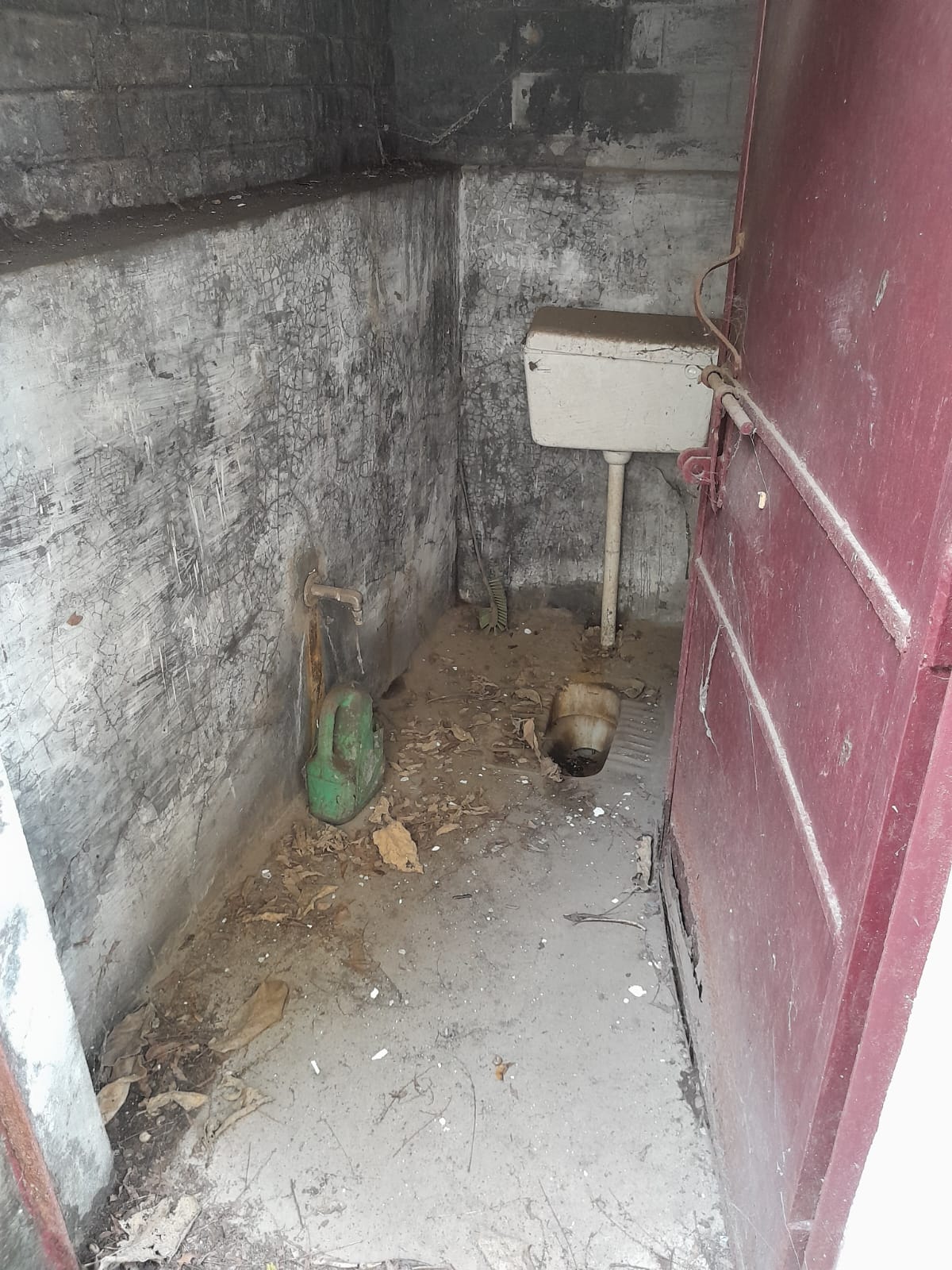
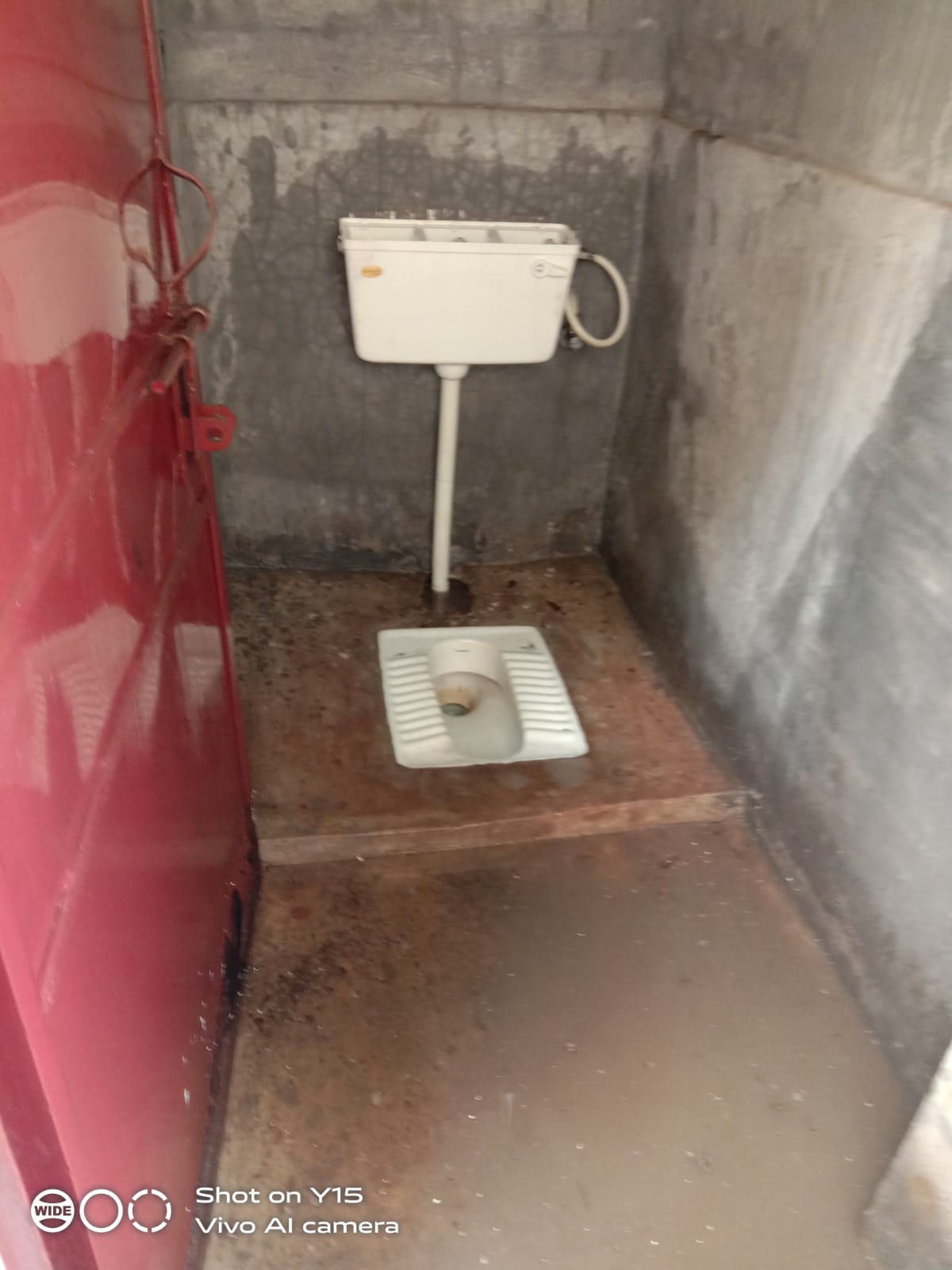
The pictures that I am going to post in this article will not be something pleasant. In fact, it will come across as revulsive to most of you. My wife Anjali was even wondering whether we should post it on social media because she felt people only like to read and share beautiful and pleasant things, nobody wants to share ugly and unpleasant things. I decided to go ahead with posting, along with a write-up, that would explain the philosophy behind it.
Today we took up the challenge to clean the abandoned toilets and washrooms of Neev Centre: a place where we couldn’t dare to stand. Ever since we came to NEEV Centre after a two-year gap, we did cleaning work, except for the back side toilets and the room where we store wood because that was not of immediate use. However, it was there in our minds that we had to clean them someday.
Our capitalistic world has created a world of duality where we hide the unpleasant and the ugly behind a curtain and create a world of classes. I would not say that work division is an outgrowth of capitalism, as it has existed since time immemorial in all human societies, leaving the tribal ones. We denigrate and demean the tribals, but these are the societies where there was no real division of labour. All other societies, ranging from feudal to present-day capitalism, are fuelled by the division of work into classes. All civilization is created by the slave labour. From the pyramids to the modern skyscrapers, to architectural marvels that we proudly honour; what lies behind their magnificence and glitz is a gory tale of slaves living in such horrible conditions that would cause us nausea. It’s a hidden tale of exploitation and deprivation which rarely any history book shall cover. History is the history of kings and emperors and aristocrats and thinkers, it is not the history of slaves who, in the first place, made the work of all these classes possible. Today we don’t have slavery as an institution, but we have a sophisticated class system, caste system and racism in its place. At one point in my life, I thought that I could cause a change in the world by changing systems, and that is what attracted me to communism. But then I gradually realized that systems are made from human thought and thought itself is the culprit. Communism established itself in various countries. But the very communism which was meant to uproot class consciousness created totalitarian regimes, with the communist leaders bathing in bathtubs of gold while the working class being pushed to greater subjugation and poverty. So I realized that it is not systems but thought that is the culprit. And the root culprit, both psychologically and metaphysically, is duality: the duality between good and bad, beautiful and ugly, pleasant and painful, pleasing and horrifying.
When we cling to duality, we cling to one side of the equation of life. In non-duality, there is no polarity, so nothing left to cling to. Our societies condition us to view life dualistically. We all grow up with a “tinsel town” imagination of the world. Like Buddha was shielded from sickness, ageing and death, all of us are shielded from the ugliness of life. A curtain is drawn over those aspects of life that are revulsive, ugly and degrading. A decade back, as a social worker, I used to work in a leprosy slum. We did a lot of work there related to health and hygiene, curing many people from tuberculosis. Further, we worked on the education of slum kids and livelihood options for women. How many of us would dare venture into a slum, let alone a slum where there are leprosy patients. But the slums are the places from where your maids come, from where the sweepers, toilet cleaners, rubbish cleaners, sewage cleaners, drivers, and construction workers come. These are the wheels of the city. If these legs and hands stop working, the tinsel towns we thrive in today would be reduced to huge mounds of debris in a matter of days. And how do we as a society treat them? We hide them as an ugly underbelly. Because as a society, we sustain and nourish a duality between hand work and head work. Headwork is considered superior to handwork. This duality is the root of an exploitative caste and class system. Many of you would be surprised to know that as an NGO we rarely get funding from other organizations or government agencies for working in slums because almost all slums are on illegally occupied lands. Being occupants of illegal lands, they are not even given access to state welfare schemes because they cannot produce land documents to make Adhar cards etc. So we have disenfranchised those very people who make our cities possible. This is a case of interior colonization and the scale is vast.
How would life be if we did not harbour psychological and metaphysical duality? A few years back, I wrote an article on death. A Canadian reader commented that he was surprised with the number of times I used the word “death” in my article. He said that people in his place don’t want to use that word. They use euphemisms like “passing away” etc. Life is beautiful and death is morbid. Duality always makes us cling to one pole even though life as a whole is not dualistic. Life cannot be separated from death, pleasure cannot be separated from pain and beauty cannot be separated from ugliness. Thus, all non-dual paths teach various ways to deconstruct this duality. Krishnamurti talked about how death has to be faced as a fact while living. Such a psychological obliteration of the boundary between life and death would bring us to “living and dying from moment to moment”. In the Bag of Bones, A Miscellany on the Body compiled by Bhikkhu Khantipalo, he writes:
“When the emphasis is so much on sensuality, youth, and beauty as we find now, the darker sides of life get pushed away and attempts are made, always unsuccessful, to sweep them under the carpet. Those who try to do so will not be pleased with the exercises contained in the Buddha’s contemplation of the body. Such things will appear to them as morbid and unnatural. Yet they are also a part of this life and should not be ignored. And if the effort is made to ignore what is unpleasant about the body, sooner or later one will be jolted into the recognition of these things. Such jolts are not pleasant. Rather than leave it until one is forced to know the body’s unpleasant sides it is better to acquaint one’s emotions with this knowledge gradually.”
In this book, Bhikku Khantiplao has compiled a set of Buddhist reflections which help seeker confront the duality mind is conditioned with and see things in the true non-dual way. There are several teachings in Buddhism and Tantra which teach the seekers to overcome duality between the pleasant and the horrifying, one of the teachings being that students should sit in the cremation and the charnel grounds and watch the dead. These practices bring equanimity. In several passages, Krishnamurti describes himself looking at a procession of a dead man being taken to the funeral grounds, and he is quietly following them. To develop equanimity towards the body, I am just quoting two passages from Buddha’s teachings:
Gratification and Danger in Form (Body)
“And what is gratification in the case of form (body)?
“Suppose there were a girl of warrior-noble cast or brahmin caste or householder stock, in her fifteenth or sixteenth year, neither too tall nor too short, neither too thin nor too fat, neither too dark nor too fair: is her beauty and loveliness then at its height?”
“Yes, venerable sir.”
“Now the pleasure and joy that arise in dependence on that beauty and loveliness are the gratification in the case of form.
“And what is danger in the case of form?
“Later on one might see that same woman here at eighty, ninety or a hundred years, aged, as crooked as a roof, doubled up, tottering with the aid of sticks, frail, her youth gone, her teeth broken, grey haired, scanty-haired, bald, wrinkled, with limbs all blotchy: how do you conceive this, bhikkhus, has her former beauty and loveliness vanished and the danger become evident?”
“Yes, venerable sir.”
“Bhikkhus, this is the danger in the case of form.”
— M. 13, “The Mass of Suffering,” trans. Ven. Ñanamoli
N.B. Women reading this should change the sex of the person in the above.”
The Discourse on Victory
Walking or standing, sitting, lying down,
[The Buddha:]
He bends it in or stretches it: this is the body’s movement.
This body by bones and sinews bound, bedaubed with membrane, flesh,
And covered up with skin — is not seen as it really is.
Filled with guts, with belly filled with liver-lump and bladder,
With heart, with lungs as well, with kidneys and with spleen,
With snot and spittle, and with fat and sweat,
With blood, and oil for the joints, with bile, and grease of the skin;
Then by nine streams the unclean flows forever from it:
Eye-dirt from the eyes, ear-dirt from the ears,
Snot from the nose, now from the mouth bile is spewed,
Now is spewed out phlegm, and from the body sweat and dirt.
And then its hollow head is stuffed with brains;
The fool thinks (all is) beautiful — led on by ignorance.
But when it’s lying dead, bloated up and livid blue,
Cast away in the charnel ground, even kin do not care for it.
Dogs eat it and jackals, and wolves and worms,
Crows and vultures eat it, and whatever other creatures are.
Wise the bhikkhu in this world who having heard the Buddha-word,
The body he knows surely and thoroughly, he sees it as it really is,
(Thinking): As this (living body) so that (corpse was once),
As that (corpse is now) so this (body will surely be) —
So for the body, within and without, discard desire.
Such a bhikkhu, wise, discarding desire and lust in this world,
Attains to deathlessness, to peace, Nibbana the unchanging state.
Pampered is this foul, two-footed, fetid thing,
Though filled with various sorts of stench and oozing here and there:
He who with such a body thinks to exalt himself,
Or should despise another — what else is this but blindness?
— Sutta-Nipata, Vijaya Sutta, Verses 193-206
Source: https://www.accesstoinsight.org/lib/authors/khantipalo/wheel271.html
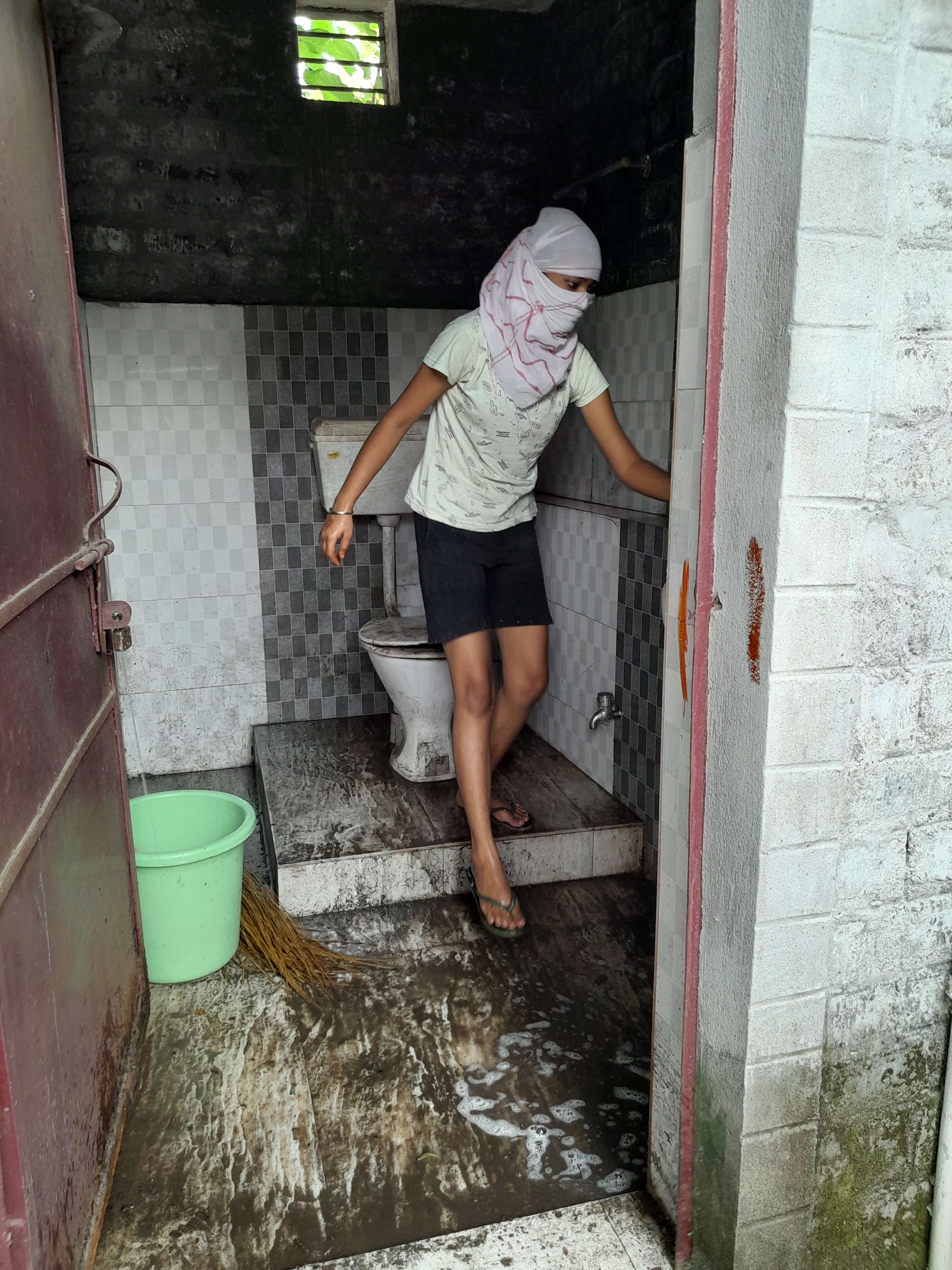
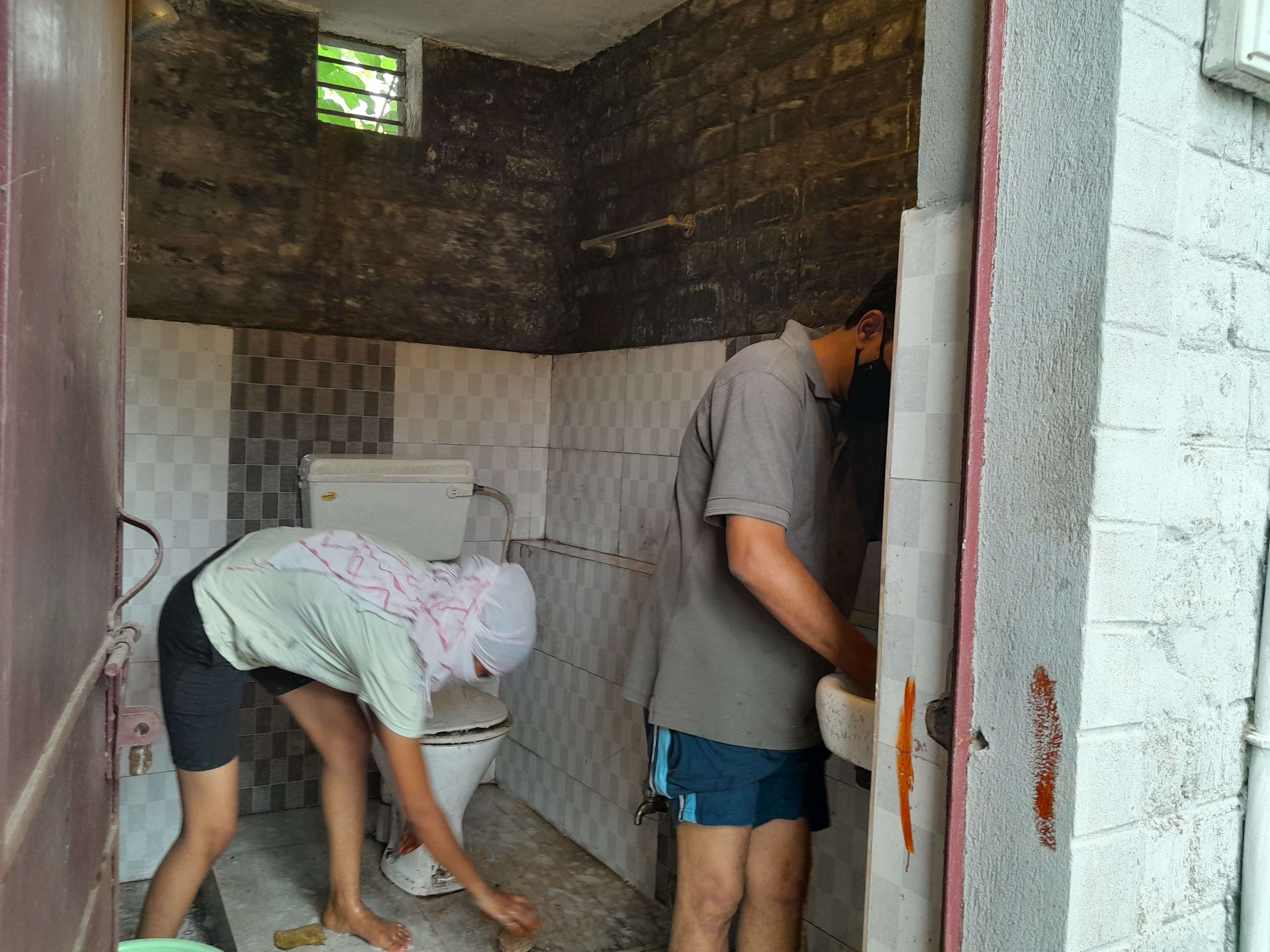
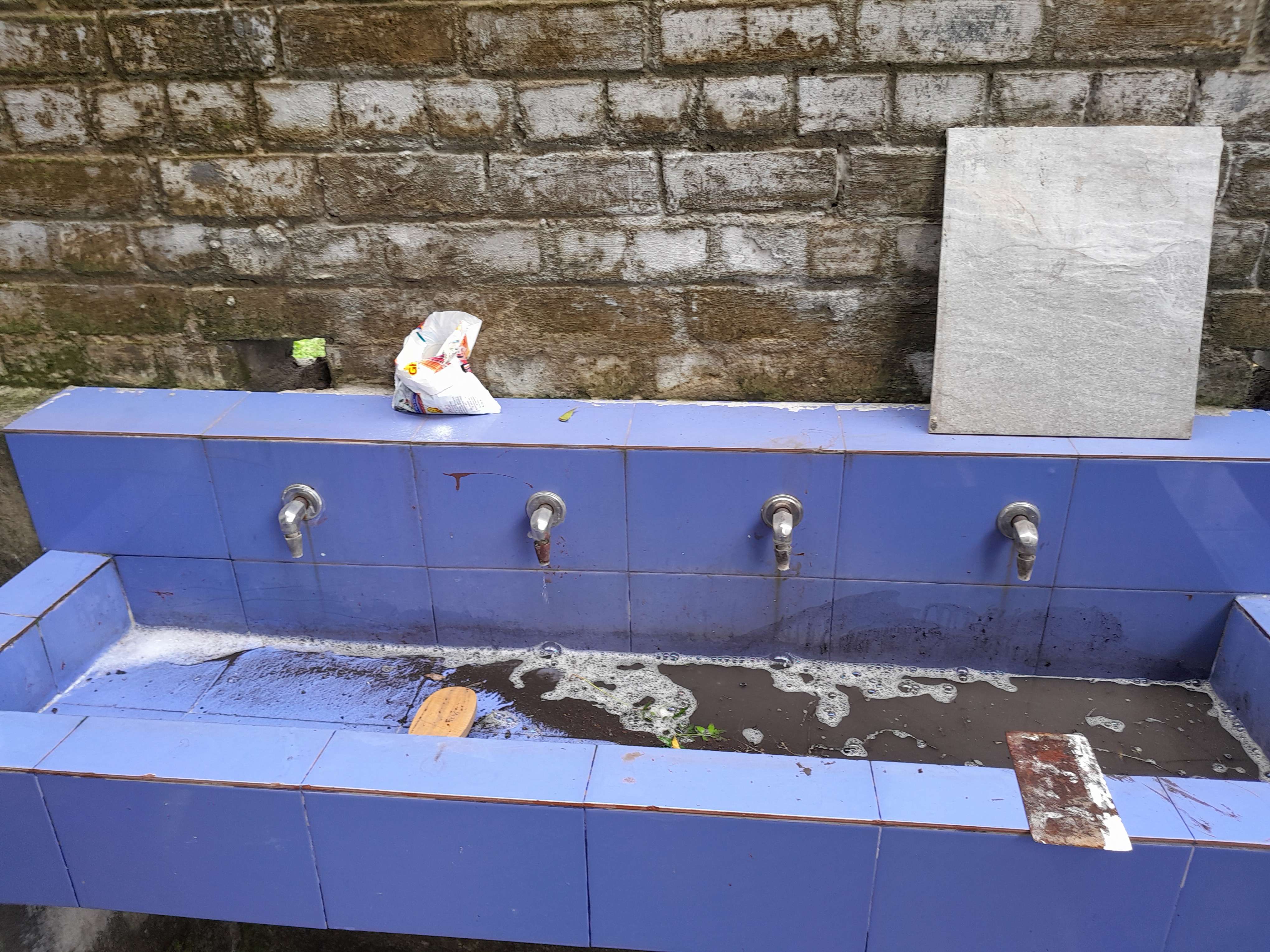
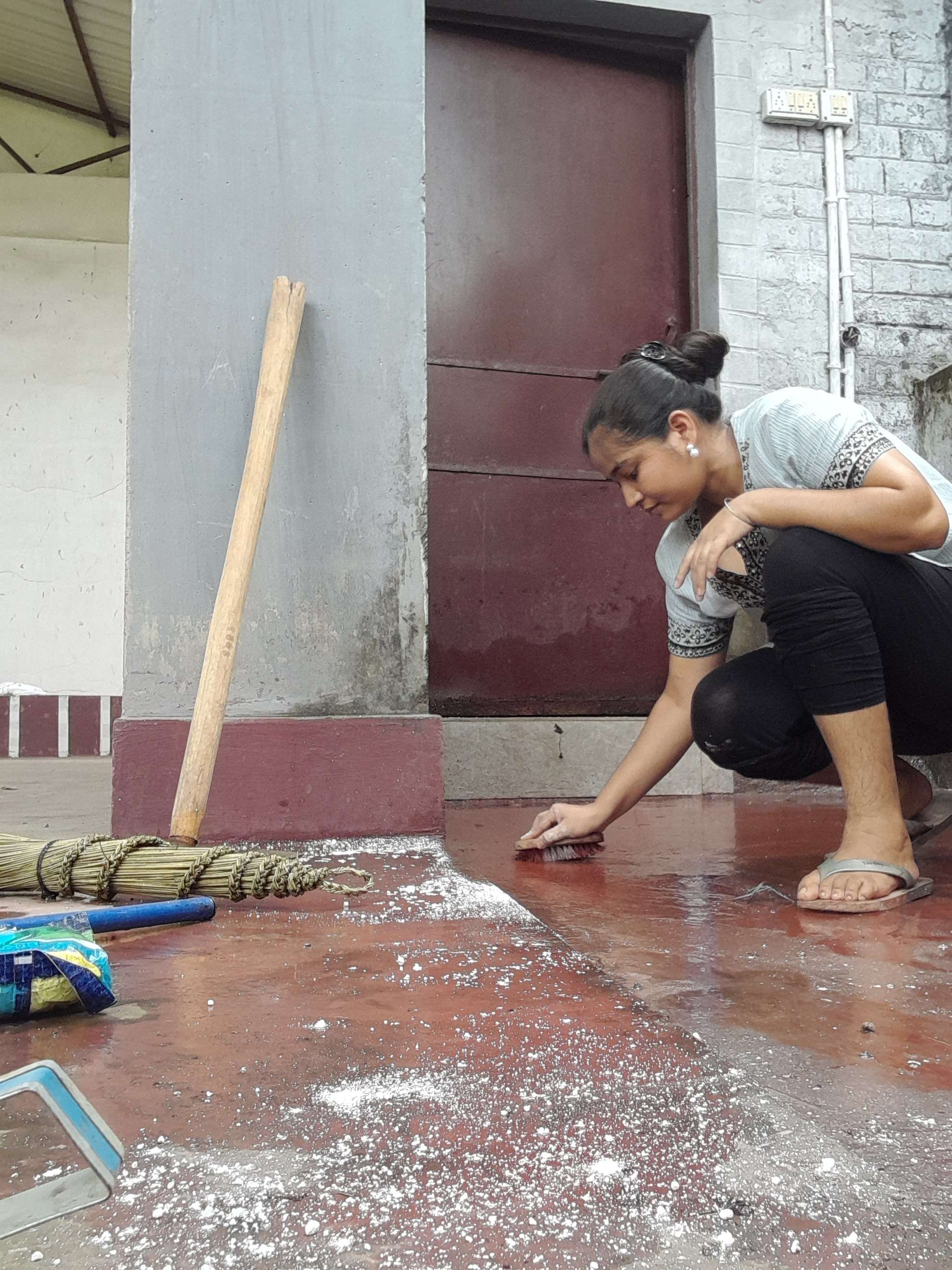
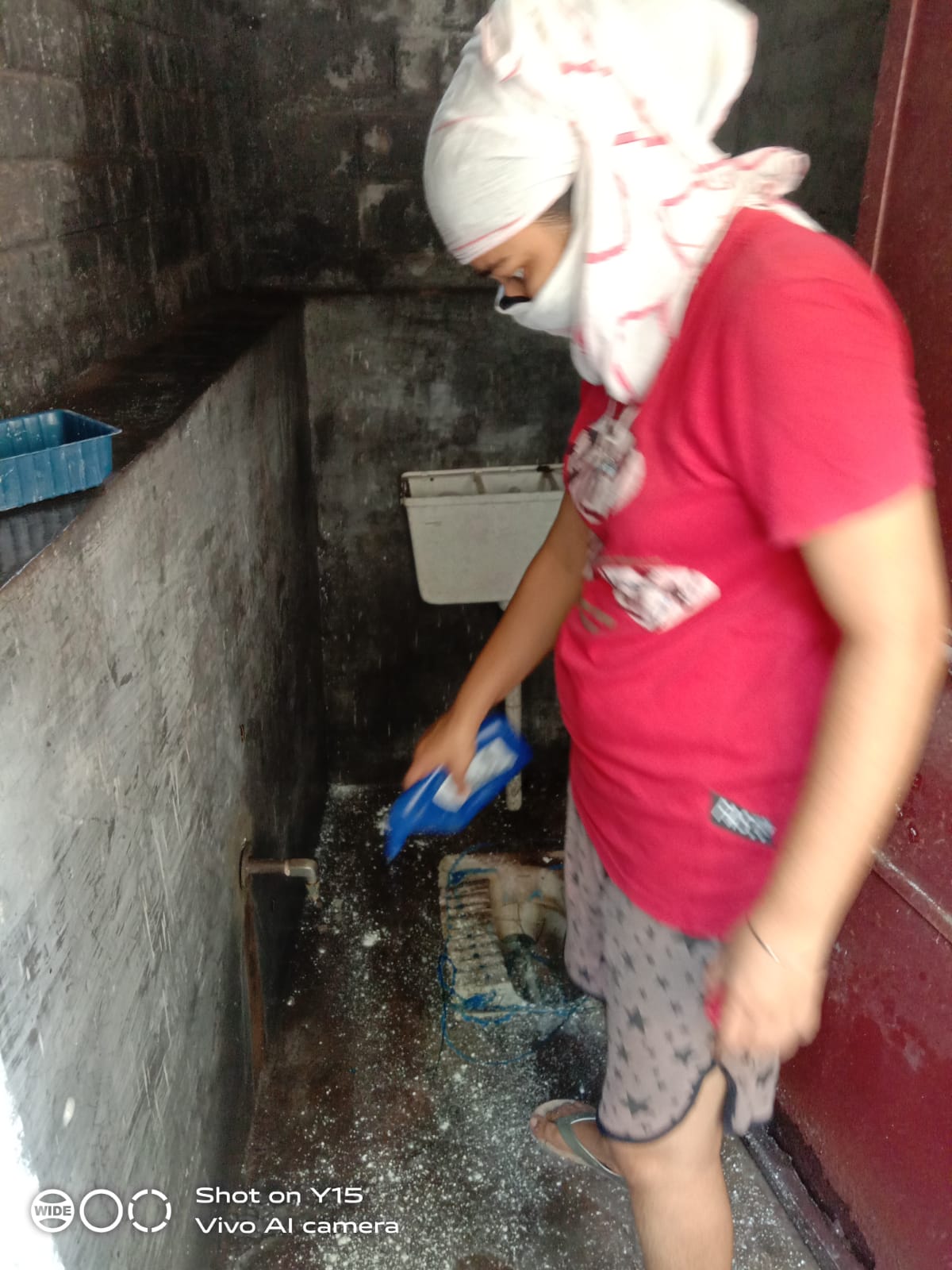
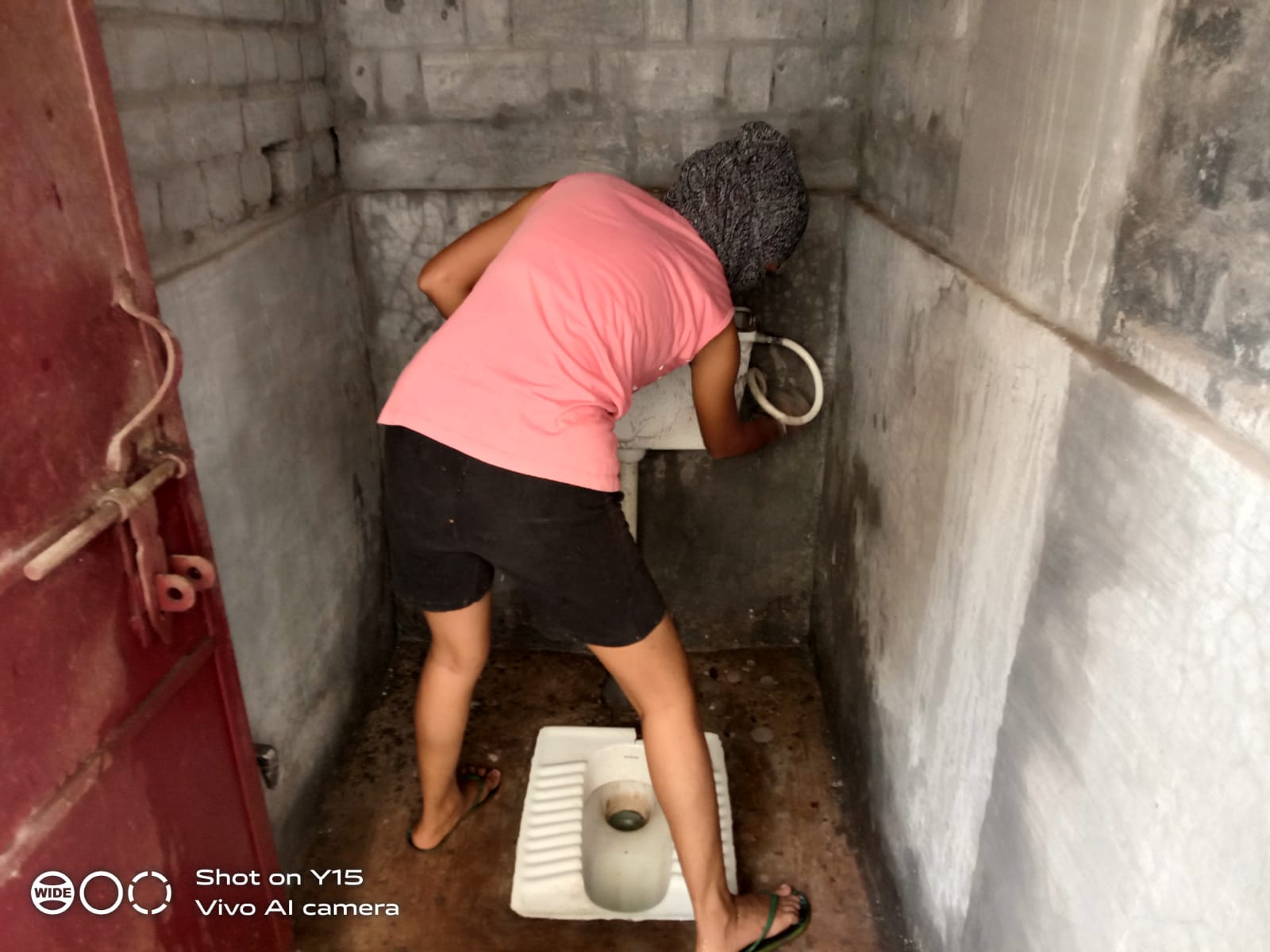
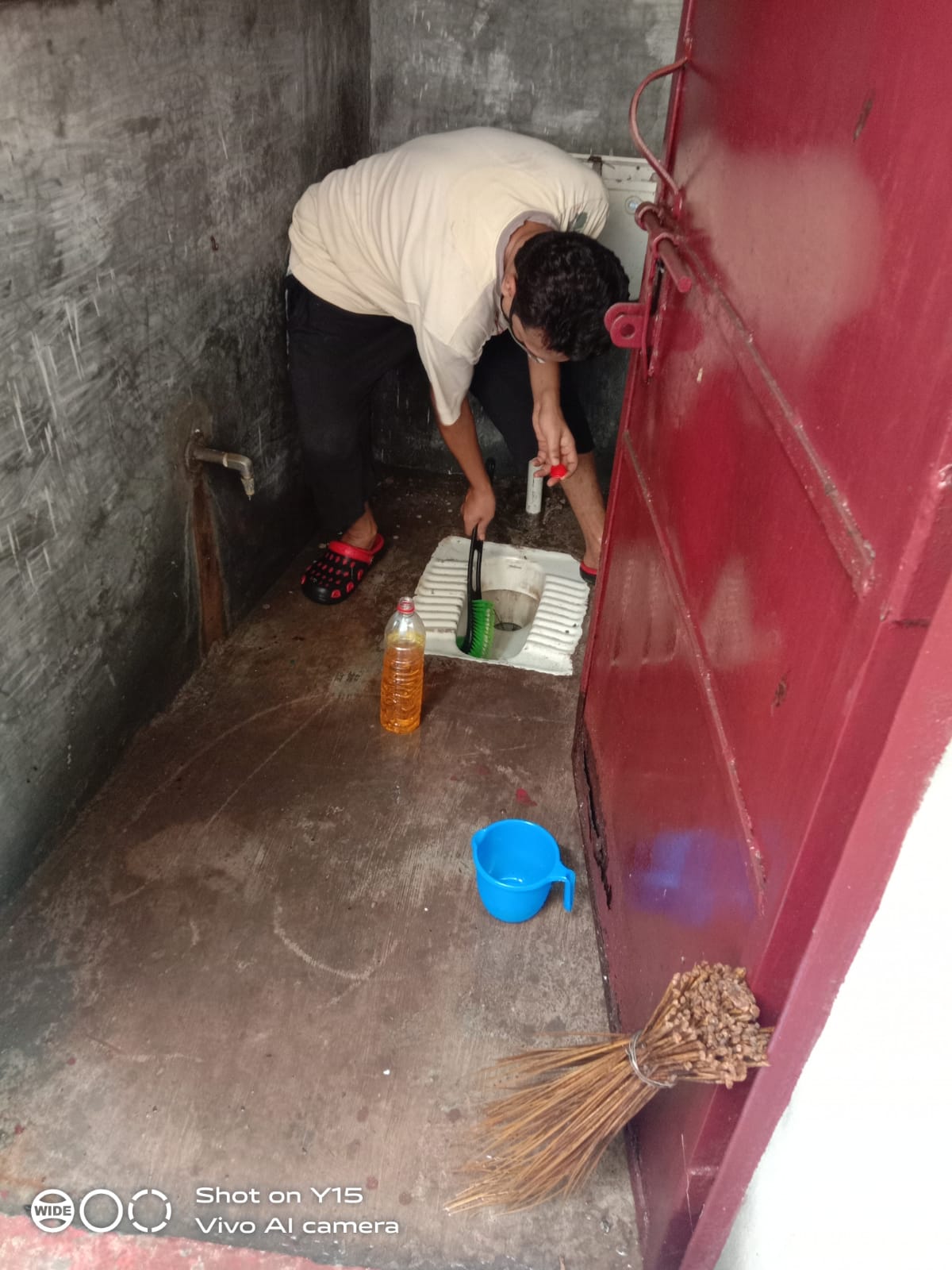
What we did today was an exercise to confront duality. I have always talked about erasing the duality between handwork and headwork because I see this as the root of all economic exploitation in the world. This was one of the reasons I took up woodworking as a hobby. Though this greatly challenged the duality between handwork and headwork, what we did today challenged this and the duality between the ugly and the beautiful. We had to clean the washrooms in the back area of the centre, which we had left abandoned for the past three years. They were filled with cobwebs and sludge-like dirt. They were so dirty that we did not even dare open the doors and peek inside. In fact, two days back, I challenged Anjali that if she could just look inside and tell me what is their condition I would give them Rs. 200. In fact as I write, I can still feel some rasping sensation in my throat due to the cleaning acid and bleaching powder fumes that we inhaled during the cleaning process. I am posting the pics of the work we did. They won’t be a pleasant sight to behold but they are the undeniable fact of life. Seen in the pics are my wife Anjali, her sister Tannu and myself.







 Neev Community for Self Inquiry & Sustainability
14 replies on “Cleaning of Washrooms and Non-Duality”
Very lucid explanation. Of course there is nothing conflicting in cleaning toilets to maintain hygiene and embracing non-duality. After all what is inside only came out 🙂 which is called shit.
One thing I have understood is that cleanliness is possible only if people using the facilities do not dirty them in the first place.
Slum is a creation of irresponsible people expecting others to solve their problems.
Thanks for sharing
LikeLike
Dear Asogan,
Thank you for your comment. The only thing I would like to address in your comment is about the irresponsible nature of slum dwellers. This is quite a complex topic. Since I have closely worked with slum dwellers, I can say that they cannot be solely blamed for what they are. If one goes into this whole issue quite deeply, if one probes how slums are born in the first place, one shall see that it is a result of capitalism in society. And capitalism is nothing but a manifestation of greed, competitiveness and power seeking in the human mind. So ultimately we all are responsible for the creation of the slums we see around us. It is our mind that has created the society that we see. As Krishnamurti said, “We are the world”.
Warm wishes,
Anurag
LikeLike
“We are the world” applies to ‘capitalism” too. JK had been only talking 🙂 and what changed???
Out of compassion or out of need to get attention we justify the existence of slums. All slums have electricity, TV, mobile phones but to keep their toilets clean …… 🙂 we find external reasons
LikeLike
Dear Asogan,
Live in a slum and you shall know what I mean. I don’t have any need for gathering attention in life by showing compassion for slum dwellers. I was in social work and I left all that. I was simply stating how slums are formed. No one intentionally wants to live in a slum. You have to deeply understand how Capitalism uproots people from their lands, displaces them and forces them to live in slums.
And yes, “We are the world” applies to Capitalism too. That’s precisely what I meant. We create a capitalistic world. Perhaps you did not understand my comment. I had shown the link clearly.
The world has not changed since Krishna or Buddha or Shankara……..nothing specific to Krishnamurti.
Warm wishes,
Anurag
LikeLike
Dear Mr Anurag jain,
I have fully understood you 🙂 That is why responding.
It may be true that “No one intentionally wants to live in a slum.” But the same ones living in slums should “intentionally” move out or make them “un-slum”. That is the point. I pointed out that they have electricity, TV, mobile, gas, cars and 2 wheelers. Do you call this poverty? But they live in “slum” and do not maintain cleanliness and toilers are stinking. And others have to point out and clean them………………… Even they are “educated” in schools!!!!!!!!
“Capitalism” is one big word to which all social problems are attributed to. Any governance is always by “rich and powerful” backed up by slum dwellers. This may continue forever as organizing human society is a complex process with multidimensional human needs and greed are to be optimized!!!!!. Sort of tradeoff game. So players and spectators will be there. Winners and losers will be inevitable. Communism and socialism also “failed”. So called social and philosophical gurus/saints/”authors” had their own interpretations of these situations and had their glory by talking about it.
The whole point is human beings always “choose” and live as they want. Will someone say tribal groups are living in slum????
At the best slum dwellers should be taught the ways to keep their environment clean and shit free. Then they choose to live as they want.
I have seen many “JK” followers( worshippers actually ) without contributing in any way to society but simply talking philosophy, and blaming others for the societal problems. Mostly they are unemployed for their reasons. One fellow I know has many books ( few never opened as the wrappers are still there), stacked in his living room with 100s of old newspapers stacked up like a heap of waste, right in the middle of his living room creating such a mess, worse than slums. Listen to him even JK will shed tears ..
People choose and live as they want.
With best regards,
LikeLike
Dear Asogan,
I have fully understood you 🙂 That is why responding.
Anurag: Thank you for taking out your time for responding. Though, I am curious to know what you have understood of me.
It may be true that “No one intentionally wants to live in a slum.” But the same ones living in slums should “intentionally” move out or make them “un-slum”. That is the point. I pointed out that they have electricity, TV, mobile, gas, cars and 2 wheelers. Do you call this poverty? But they live in “slum” and do not maintain cleanliness and toilers are stinking. And others have to point out and clean them………………… Even they are “educated” in schools!!!!!!!!
Anurag: My question was about how slums are created in the first place. Do you know the history behind the creation of slums? Do you think that a set of people intentionally choose to reside in slum like situations? I don’t know which slums you have visited, but because slums are on illegal lands, they mostly do not have any access to water. They also do not have toilets for the same reason. I am not talking about the psychology of people living in slums. That is a different point. I think that their psychology is just like any other human being. I am saying that the odds that they have to face in coming out of their circumstances are much more compared to people who are born in other classes. My question is about the rise of class system, the roots of it. Even slum dwellers are not free from class system psychologically.
“Capitalism” is one big word to which all social problems are attributed to. Any governance is always by “rich and powerful” backed up by slum dwellers. This may continue forever as organizing human society is a complex process with multidimensional human needs and greed are to be optimized!!!!!. Sort of tradeoff game. So players and spectators will be there. Winners and losers will be inevitable. Communism and socialism also “failed”. So called social and philosophical gurus/saints/”authors” had their own interpretations of these situations and had their glory by talking about it.
Anurag: I have never posited any “system” as a panacea for human suffering. This is why I asked you in the first place, what you have understood of me. Whether it is capitalism, socialism or communism, all systems are driven by human thought and therefore prone to the fallacies of psychological thought conditioning. Till humans do not get liberated from psychological thought, inequity and its attendant suffering will prevail.
The whole point is human beings always “choose” and live as they want. Will someone say tribal groups are living in slum????
Anurag: I don’t know how much you know about the history of slums, but many people in the slums are tribals and villagers who have been displaced off their lands by large developmental projects.
At the best slum dwellers should be taught the ways to keep their environment clean and shit free. Then they choose to live as they want.
Anurag: At the best, all humans should feel responsible to remove their conditioning induced by psychological thought.
I have seen many “JK” followers (worshippers actually) without contributing in any way to society but simply talking philosophy, and blaming others for the societal problems. Mostly they are unemployed for their reasons.
Anurag: Do you have an axe to grind against Krishnamurti? It seems like it. Are you considering me to be a follower or worshipper of Krishnamurti? If yes, then again you do not know me, and you will have to read my blogs where I have talked about Krishnamurti. My entire blog, as such, it is about self inquiry which is not based on any beliefs. Following any teacher or teachings “without understanding” is like believing a teacher/teachings. If I learn maths from a teacher, I do not have to believe in a teacher. I do not have to believe in Pythagoras theorem. If I understand it, it is seen to be a self-evident truth. A huge portion of Krishnamurti’s teachings are self-evident. You do not need to follow or believe in what he says. You can see what he says for yourself. There are advanced parts of his teachings which are not self-evident and involve a hidden belief, and these are parts which I have critiqued.
Now, your second point is about contributing to society. I have not only delved long into it, but also worked for almost two decades in the field of social work, having started my own NGO. After doing all this, I am doing what I think is my greatest contribution to society: teaching people the way out of suffering through non-dual self inquiry. When a mind is liberated from psychological thought, it becomes spontaneously compassionate. It’s not a compassion driven by systems and ideals. Actually, this what Krishnamurti too said.
One fellow I know has many books (few never opened as the wrappers are still there), stacked in his living room with 100s of old newspapers stacked up like a heap of waste, right in the middle of his living room creating such a mess, worse than slums. Listen to him, even JK will shed tears ..
People choose and live as they want.
Anurag: I did not quite understand what was the point you were trying to make here. Yes, people do choose the lives they want. But until they are not freed from psychological thought, their choices are made within a conditioned field. That is why I teach people the way to true freedom. Of course, I can do this to only those who are ready to receive this.
With best regards,
Anurag
LikeLike
Dear Mr Anurag Jain,
I have no axe to grind 😊😃, I am a thinker and a problem solver. I am reasonably successful in that. So drop that idea.
If you think you are contributing to society, so be it and I wish you well.
Just have some reasonable metrics to assess your effectiveness.
With warm regards
Asogan
LikeLike
Dear Asogan,
Thanks for your good wishes. I am still curious what brings you, being a succesful thinker and problem solver to my blog 🙂 Are there any problems you are still looking to solve?
If you really go through all that I have written in my blog, you shall see that I have no concept of me as a thinker/doer/experiencer left, so having metrics to assess my effectiveness is entirely superfluous.
My best wishes to you too.
Warm regards,
Anurag
LikeLike
Hello Mr Anurag Jain,
I chanced upon your blog once and for some inexplicable reason did not unsubscribe 😊. Suddenly out of blue , I get your “slum” improvement project photos. Then … this is happening. Some random event. Of course your english is good and your thoughts are typical of people trying to do ” good ” to “poor” people. Sort of harmless hallucinations with philosophical musings.
All the best. Thanks for your wishes. If you happen to be in Chennai let me know to have tea together and chat for some time.
With best regards
LikeLike
Dear Asogan,
My hunch was right. There was a reason why I kept asking what you have understood of me. You have not quite read my article 🙂 My article was not on a “slum improvement project”, it was on Advaita/non-duality. The photo was of the toilet in our NEEV Centre for Self Inquiry and not of any slum.
Secondly, I am not a social worker. I left social work six years back. I am an Advaita Teacher and my entire blog, including my article with the toilet cleaning photos, was on Advaita, not on helping any poor people or slum people.
So, it is you who have been hallucinating all along sir 🙂
Warm wishes,
Anurag
LikeLike
Dear Mr Anurag,
Ha ha ha..
“Today we took up the challenge to clean the abandoned toilets and washrooms of Neev Centre: a place where we couldn’t dare to stand”
Yes …. clearly speaks of the attitude of the people running this centre. Worse than slum level and eloquent in justifying that. I have put “slum” in quotes which non hallucinating humans would have noted.
Carry on with your line of “works’ and with best regards.
LikeLike
Dear Asogan,
Your first response had said, “Very lucid explanation. Of course there is nothing conflicting in cleaning toilets to maintain hygiene and embracing non-duality…………………………………..Slum is a creation of irresponsible people expecting others to solve their problems.” And our subsequent exchanges were on slums, which had evidently nothing to do with the Centre. So your quotes on the word “slum” do not seem to point to our Centre, given the context of our conversation so far.
Secondly, you have written about my “thoughts are typical of people trying to do ” good ” to “poor” people”, whereas my entire blog has nothing to do with social work or doing good to the poor. My blog is about Advaita, which you have not mentioned a word about so far, despite me mentioning it several times.
Since you have not read the article at all, you have entirely missed out the context of the article. The first point mentioned in the article is that a part of the Centre was in an abandoned state for the past few years because of some reasons, and so we had to clean the toilets and secondly, I did not present any justifications.
I was merely stating facts about what was the state of the back side Centre toilet and what we did to clean it, in order to prepare for the upcoming first Advaita retreat. But the main intent was to talk about Advaita through this event.
Warm wishes,
Anurag
LikeLike
Dear Mr Anurag Jain,
Thank you for your interactions. It was really enjoyable😊
Wish you all the best,
LikeLike
Dear Asogan,
Thank you so much for your interaction, too.
Wish you all the best too,
Anurag
LikeLike