
Introduction
Advaita and Buddhism are two non-dual paths that talk about liberation from suffering. Theravada Buddhism is a school of Buddhism that claims to be based on the original Pali transmission of the Buddha. In this article, I am examining both these paths through quotes and explanations to illustrate what they mean by liberation, what causes bondage and what is the nature of liberation. In the firmament of non-dual paths, there are many who believe and uphold that Advaita and Buddhism are talking of two different truths, while there are also many who believe that they are talking the same truth. I fall into the latter group. In this article I show the similarities of both these paths and leave the reader to decide for himself
Non-Dual Reality and Freedom from Suffering
All non-dual paths lay a lot of stress on direct experience and insight. They all agree that suffering is a result of not seeing the reality “as it is”. Rather, due to avidya/conditioning/ignorance we misperceive reality and are bound to the wheel of suffering/samsara through our fears and desires. The way out of suffering is to see reality “as it is”. Reality “as it is” is non-dual, which means that there is no subject-object duality. Which, in turn, means that there is no individual subject experiencing a world of objects and other subjects. This dualistic view is the root of all conflict and suffering. Thus, all non-dual paths attempt to help seekers of truth understand that there is no subject-object duality in actuality. This division is actually caused by avidya/ignorance and each non-dual path provides a way by which a seeker can overcome this ignorance, overcome duality, and finally overcome suffering.
The subject-object duality is maintained by the deeply seated ignorance that there are inherently existing substantial subjects and objects which, amongst other dualities, primarily gives rise to an experiencer experiencing a world of objects. The primary duality of the experiencer and the experienced is the root of samsara/the world of fears and desires. We suffer both in the waking and dream states when the duality of experiencer and experienced is operating. However, there is a total cessation of suffering in the sleep state, when this duality ceases to exist. This experience is a clue to find a way out of suffering. Thus Shankarachara says:
“Verse 10.13 – He who, in the waking state, like a man in the state of deep sleep, does not see duality, though [actually] seeing, because of his non-duality, and similarly he who, though [in fact] acting, is actionless—he [only]is the knower of Atman[non-dual reality], and nobody else. This is the firm conclusion here [in the Vedanta].
~ Upadeshasahasri, Verse 10.13
In Part 1 of this two parts article I am going to examine the mechanism of duality: how it is created, sustained and leads to suffering, as described in two non-dual traditions of Advaita Vedanta and Theravada Buddhism. In this part I shall also be giving a theoretical description of the solution offered by both these paths to end the suffering caused by duality. In Part 2 of this article, I shall be going more deeply into the practical application of the solution offered to end duality and suffering.
How Duality is Overcome by Non-Dual Paths
The duality of subject-object can be destroyed by seeing through the fact that there is in reality no subject or no-self and that there are no substantial or inherently existing objects either. The duality of names and forms/subjects and objects is just a superimposition. They do not really exist inherently or substantially. The names and forms are useful for us technically to helps us with our empirical reality. They provide a framework of knowledge to carry out daily transactions of life like farming, cooking, communicating, building houses and all forms of science and technology. But the problem arises when we take this conventional reality to be the ultimate reality: as the way things actually are. Because if we treat names and forms seriously, we sink into separation and conflict. If we understand that names and forms are just conventional designations, rather than realities, then even when seeing them we shall still have a non-dual vision. What is a non-dual vision?
Buddhists would put this experience as what the Buddha says in the Bahiya Sutta:
“This is how you should train yourself. When for you there is in what is seen only the seen, in what is heard only the heard, in what is sensed only the sensed and in what is cognized only the cognized, then Bahiya there is no you in connection with what is seen, heard, sensed or cognized, there is no you there. When there is no you there, you are neither here nor there nor anywhere in between. This and only this is the end of stress and unhappiness.”
~ Bahiya Sutta, Udana 1.10
In the verse quoted, Buddha is saying that if we see deeply, there is actually no seer or self in any experience. All experience is just about the seen, heard, sensed and cognized without any seer, hearer, experiencer or cognizer. In essence, he is trying to say that there is no self or no thinker/doer/experiencer.
Gaudapda, the Advaitin, talking about no-self, says in a similar vein
“No Jiva (self) is whatsoever born; there is no origin of it. This is that ultimate truth where nothing whatsoever is born”
Verse 3.48, Mandukya Karika
However, the interesting difference between the approaches of Buddhism and Advaita is that while Buddhism resolves the subject-object duality by the total elimination of subject/self from experience, Advaita resolves it by the total elimination of all objects from the experience. So we have the following nature of non-dual experience reported by Advaitins in Vivekachudamani.
“By fixing the purified inner equipment upon the Self which is the Witness and Knowledge Absolute, and little by little making it quiet, one must try to realize one’s infinite Self”
“Free from all limitations like the body, sense organs, Pranas, mind and ego/self which are projections of one’s ignorance, let one come to realize the Atman, the Indivisible and Infinite, like the great endless sky”
~ Verses 384 & 385, Vivekachudamani
Thus, we see that both non-dual paths of Buddhism and Advaita overcome duality in two seemingly opposite ways. While Buddhism annihilates the subject, Advaita annihilates all objects [in Advaita self/ego is also an object]. When one pole of the duality is negated, the other pole has to vanish too. Even though the language of these two schools skews more towards the pole that was not meant to be annihilated, the actual experience is non-conceptual, beyond all descriptions, and free of all subject-object duality. However, let me leave the reader with two quotes, one from Buddha and one from Gaudapada, where even the language used to describe ultimate truth bears an uncanny similarity.
“There is, monks, an unborn —unbecome—unmade—unfabricated. If there were not that unborn—unbecome—unmade—unfabricated, there would not be the case that escape from the born—become—made—fabricated would be discerned. But precisely because there is an unborn—unbecome—unmade—unfabricated, escape from the born—become—made—fabricated is discerned.”
~ Buddha, Nibbana Sutta, Udana 8.3
“When the mind is not asleep and is also not distracted, it is motionless and without image. Then it becomes Brahman. [3.46] They say it is quiescent within itself, calm, in nirvana, indescribable, ultimate bliss, the unborn known by the unborn, the omniscient. [3.47] No jiva whatsoever is born; there is no origin of it. This is that ultimate truth where nothing whatsoever is born. [3.48]”
“Neither cessation nor origination [unbecome-unmade], neither one bound nor one practising spiritual discipline, neither one aspiring for liberation nor one who is liberated [unfabricated]. This is the supreme truth. [1.32]”
~ Gaudapada, Mandukya Karika
* the terms in square brackets in the quote above have been provided by me for the sake of comparison with the quote of Buddha above.
Both the quotes above show that ultimate reality is unborn, unbecome, unmade and unfabricated which can be discerned with a mind trained in non-dual self inquiry, or more accurately by total ending of ignorance which superimposes duality on non-dual reality.
Having understood how duality is overcome in both paths in a general way we now move towards understanding the similar theories of causation that both Buddhism and Advaita advance to say how we are enchained by duality in the first place. It must however be understood by the reader that the theory of causation is only the penultimate view of both Advaita and Mahayana Buddhism. Causation is a provisional theory advanced by these schools to help seekers climb up the ladder of non-dual inquiry in stages. In the ultimate stage, both Advaita and Mahayana Buddhism negate causation and as mentioned earlier talk about the ultimate reality as – unborn —unbecome—unmade—unfabricated
Ignorance, Desire, Action, the Law of Cause and Effect & the Wheel of Samsara
Both Advaita and Buddhism agree that the main cause of suffering is due to the Law of Cause and Effect by which human beings are haplessly bound to an eternal cycle of birth, death and the attendant suffering. The Law of Cause and Effect operates only in the realm of duality where things are born, undergo modifications and ultimately die to be born again. This world of duality characterized by incessantly transmigrating entities, bound to the law of cause and effect, called the wheel of samsara. What keeps this wheel of samsara rotating is avidya/ignorance of non-dual nature of reality.
It’s interesting to see how both Advaita and Buddhism speak about this causal chain that begins with ignorance leading to the wheel of samsara in somewhat similar terms.
The Law of Karma/Cause and Effect as per Advaita
Talking about the causal chain, Shankara says :
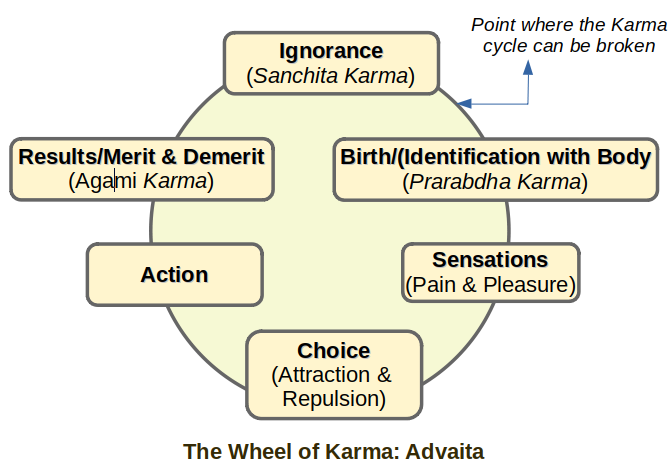
“Actions bring about one’s connection with the body [1]; when the connection with the body has taken place, pleasure and pain most surely follow; thence come attraction and repulsion, from them actions follow again, as the results of which merit and demerit appertain to an ignorant man, which again are similarly followed by the connection with the body.[2] This transmigratory existence is thus going on continually for ever like a wheel. The cessation of ignorance is desirable as it is the root of this transmigratory existence.”
~ Upadeshasahasri, Part 2, Verses 3,4&5
[1] – This embodied existence has come forth induced by a bundle of likes and dislikes. If there are likes and dislikes left at the end of this life, it will induce another embodied existence. This cycle of life after life, again and again, is called samsara. The wick, which soaks with the oil of likes and dislikes for the flame of samsara to burn, is the individual identity.
[2] – Whenever we do an action,
1.) a part of the momentum of the action transforms into the immediate visible effect (drishta phala)
2.) a part of the momentum of the action is latent to manifest the effect later (adrishta phala or aagaami karma)
3.) tendency to perform or avoid the same action based on the like or dislike of the effect of the action (samskara) is stored in the form of sanchita karma or aagami karma.
Some of the latent momentum manifests in the same life. The balance will manifest in some future life. Whenever a jiva is born, out of the accumulated store of momentum of past actions (sanchita karma), a part is taken for manifesting in that life (prarabdha karma). At the end of the life, if there is no individuality (and so no tendencies), then there is no more birth. This is called “freedom upon death” (videha mukti). If the individuality (and so tendencies) drops while living, it is called “freedom while living” (jivan mukti).
The above can be depicted graphically as:
The Law of Karma/Cause and Effect as per Buddhism
Explicating the law of Karma, Buddha said:
“All beings own their deeds, inherit their deeds, originate from their deeds, are tied to their deeds; their deeds are their refuge. As their deeds are base or noble, so will be their lives.”
~ Majjhima Nikaya.135, Cūḷa Kamma Vibhaṅga Sutta.
And further:
If ignorance arises, formations (volitional impulses) occurs;
if formations arises, consciousness occurs;
if consciousness arises, mind-and-matter occur;
if mind-and-matter arise, the six senses occur;
if the six senses arise, contact occurs;
if contact arises, sensation occurs;
if sensation arises, craving and aversion occur;
if craving and aversion arise, attachment occurs;
if attachment arises, the process of becoming occurs;
if the process of becoming arises, birth occurs;
if birth arises, decay and death occur, together with sorrow, lamentation, physical and mental suffering, and tribulations.
Thus arises this entire mass of suffering

~ Majjhima Nikaya.38, Mahā-taṇhāsaṅkhaya Sutta.
The wheel of Karma of Buddhism can be depicted by the following figure:
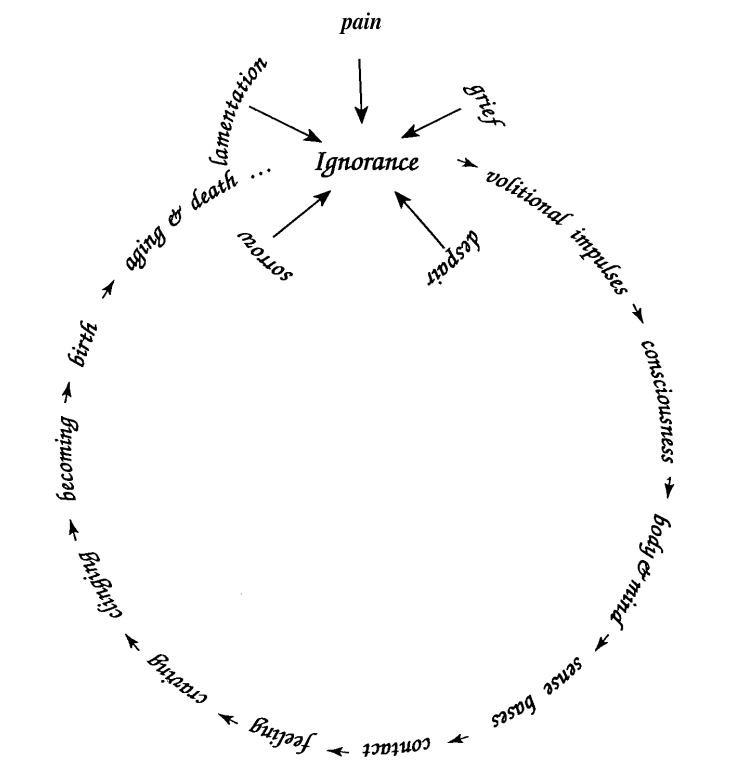
This Wheel of Becoming (bhavacakka), or Wheel of Samsara covers three lifetimes thus:
1) Past life – Ignorance, volitional impulses
2) Present life – Consciousness, body and mind, sense bases, contact, feeling, craving, clinging, becoming
3 ) Future life – Birth, ageing and death (sorrow, lamentation, pain, grief and despair)
Among these three periods, the middle period, the present, is our base. From this perspective, we see the relationship of the past section as purely a causal one, that is, results in the present are derived from causes in the past (past cause +present result), whereas the future section specifically shows results, that is extending from causes in the present to results in the future (present cause + future result). Thus, the middle section, the present, contains both causal and resultant conditions. We can now represent the whole cycle in four sections:
1) Past cause = Ignorance, volitional impulses (Sanchita Karma)
2) Present result = Consciousness, body and mind, sense bases, contact, feeling (Prarabdha Karma)
3) Present cause = Craving, clinging, becoming (Agami Karma)
4) Future result = Birth, aging and death (sorrow, lamentation, etc. ) (Sanchita Karma)
Comparing the above four sections with the Wheel of Karma as per Advaita we can appreciate how similar the two traditions are in tracing the Law of Karma or the Law of Cause and Effect, which can be summarized as follows:
Suffering begins with ignorance about the reality of our true nature, about the phenomenon labelled “I”. And the next cause of suffering is saṅkhāra (Pali)/samskara (Sanskrit), the mental habit of reaction. Blinded by ignorance, we generate reactions of craving and aversion (Choice), which develop into attachment (Action), leading to all types of unhappiness (Results). The habit of reacting is the karma, the shaper of our future. And the reaction arises only because of ignorance about our real nature. Ignorance, craving, and aversion are the three roots from which grow all our sufferings in life.
Converting the Wheel of Samsara to Wheel of Nirvana
Having understood suffering and its origin, both paths show how suffering can be brought to an end by applying the law of karma/ cause and effect in the reverse:
“If this exists, that occurs; that arises from the arising of this. If this does not exist, that does not occur; that ceases from the ceasing of this.”
~ Majjhima Nikaya.38, Mahā-taṇhāsaṅkhaya Sutta.
Nothing happens without a cause. If the cause is eradicated, there will be no effect. In this way, the process of the arising of suffering can be reversed:
If ignorance is eradicated and completely ceases, reaction ceases;
if reaction ceases, consciousness ceases;
if consciousness ceases, mind-and-matter cease;
if mind-and-matter ceases, the six senses cease;
if the six senses cease, contact ceases;
if contact ceases, sensation ceases;
if sensation ceases, craving and aversion cease;
if craving and aversion cease, attachment ceases;
if attachment ceases, the process of becoming ceases;
if the process of becoming ceases, birth ceases;
if birth ceases, decay and death cease, together with sorrow, lamentation, physical and mental suffering and tribulations.
Thus, this entire mass of suffering ceases.

~ Majjhima Nikaya.38, Mahā-taṇhāsaṅkhaya Sutta.
If we put an end to ignorance, then there will be no blind reactions that bring in their wake all manner of suffering. And if there is no more suffering, then we shall experience real peace, real happiness. The wheel of suffering can change into the wheel of liberation. The same solution is spoken of in Advaita.:
“Having caused by an error of judgement, and false understanding, the jeeva-hood (self) can exist only as long as the delusion lasts. The rope is mistaken to be the snake only when there is an illusion. Once the illusion is destroyed, there can be no snake. So, too, in this case.”
“Avidya or Ignorance and its effects are likewise considered as beginningless. But with the rise of Vidyā or realisation, the entire effects of Avidya, even though beginningless, are destroyed together with their root – like dreams on waking up from sleep. It is clear that the phenomenal universe, even though without beginning, is not eternal – like previous non-existence.”
~ Viekachudamani, Verses 197, 198, 199
Indirect Knowledge vs Direct Experience of Ultimate Reality
But having mere intellectual knowledge of how we can convert the wheel of samsara to the wheel of nirvana by eradicating ignorance is not enough. To achieve real freedom from suffering we have to possess direct experience/insight. Advaita speaks of three means of attaining to ultimate reality – shruti (listening/reading scriptures), yukti (reasoning) and anubhava (direct experience). Similarly, Buddhism too speaks of three kinds of wisdom: received wisdom (suta-mayā paññā), intellectual wisdom (cintā-mayā paññā), and experiential wisdom (bhāvanā-mayā paññā).
The literal meaning of the phrase suta-mayā paññā/shruti is “heard wisdom”—wisdom learned from others, by reading books or listening to sermons or lectures, for example. This is another person’s wisdom which one decides to adopt as one’s own. The acceptance may be out of ignorance. For example, people who have grown up in a community with a certain ideology, a system of beliefs, religious or otherwise, may accept without questioning the ideology of the community. Or the acceptance may be out of craving. Leaders of the community may declare that accepting the established ideology, the traditional beliefs, will guarantee a wonderful future; perhaps they claim that all believers will attain heaven after death. Naturally the bliss of heaven is very attractive, and so willingly one accepts. Or the acceptance may be out of fear. Leaders may see that people have doubts and questions about the ideology of the community, so they warn them to conform to the commonly held beliefs, threatening them with terrible punishment in the future if they do not conform, perhaps claiming that all unbelievers will go to hell after death. Naturally, people do not want to go to hell, so they swallow their doubts and adopt the beliefs of the community. Whether it is accepted out of blind faith, out of craving, or out of fear, received wisdom is not one’s own wisdom, not something experienced for oneself. It is borrowed wisdom.
The second type of wisdom is through manana/cintā-mayā paññā/intellectual understanding. After reading or hearing a certain teaching, one considers it and examines whether it is really rational, beneficial, and practical. And if it is satisfying at the intellectual level, one accepts it as true. Still this is not one’s own insight, but only an intellectualization of the wisdom one has heard.
The third type of wisdom is that which arises out of one’s own experience, out of personal realization of truth. This is the wisdom that one lives, real wisdom that will bring about a change in one’s life by changing the very nature of the mind. This is called anubhava/bhāvanā-mayā paññā. In worldly matters, experiential wisdom may not always be necessary or advisable. It is sufficient to accept the warnings of others that fire is dangerous, or to confirm the fact by deductive reasoning. It is foolhardy to insist on plunging oneself into fire before accepting that it burns. In self-inquiry, however, the wisdom that comes of experience is essential, since only this enables us to become free from conditioning.
Wisdom acquired through listening to others and wisdom acquired through intellectual investigation are helpful if they inspire and guide us to advance to the third type of paññā, experiential wisdom. But if we remain satisfied simply to accept received wisdom without questioning, it becomes a form of bondage, a barrier to the attainment of experiential understanding. By the same token, if we remain content merely to contemplate truth, to investigate and understand it intellectually, but make no effort to experience it directly, then all our intellectual understanding becomes a bondage instead of an aid to liberation.
Each one of us must live truth by direct experience, by anubhava/bhāvanā: only this living experience will liberate the mind. No one else’s realization of truth will liberate us. Even the enlightenment of the Buddha could liberate only one person, Siddhartha Gotama. At most, someone else’s realization can act as an inspiration for others, offering guidelines for them to follow, but ultimately we each must do the work ourselves. As the Buddha said:
“You have to do your own work; those who have reached the goal will only show the way.”
~ Dhammapada. XX. 4 (276)
The Path to Direct Experience of Reality in Advaita – Knowledge/Insight based Samadhi
The processes that lead to liberation in Advaita are:
- Sadhana Chatusthaya – A set of mental disciplines that prepare the seeker for Jnana Yoga of Advaita
- Sravana – Listening to Scriptures
- Manana – Reflection on the truths ascertained through the scriptures, assisted by dialogues with the teacher till all doubts are resolved and results in insight (akhandakara vritti) about the nature of reality
- Nidhidhyasana – Firm establishment in the insight through deep contemplation and removal of all vasanas/mental impressions.
The way of attaining the full-fledged direct experience of non-dual reality in Advaita is through the constant application of knowledge of the true nature of Self/Witness gained by the gnostic insight called akhandakara vritti, till it wipes out all object perception and one arrives at the experience that “Everything is Brahman/Awareness”. I have written in detail about how one arrives at the akhandakara vritti in my article Self inquiry and insight into one’s true nature/Self in Advaita
Following are the quotes from a famous Advaita book called Vivekachudamani which talk about the different stages of the path I have outlined above.
“On the Truth, (Self Knowledge), one must oneself meditate in one’s mind [manana], through the intellect, by means of the recognized arguments [heard/read during sravana]. By that means one will realize the truth free from doubt etc., like water in the palm of one’s hand [nidhidhyasana].”
~ Vivekachudamani, verse 264
Verse 362: When the mind, thus purified by constant practise [of Self Knowledge], is merged in Brahman, then Samadhi passes on from the Savikalpa to the Nirvikalpa stage, and leads directly to the realization of the Bliss of Brahman, the One without a second.“
Verse 363: By this Samadhi are destroyed all desires which are like knots, all work is at an end, and inside and out there takes place everywhere and always the spontaneous manifestation of one’s real nature.”
Verse 364: Reflection should be considered a hundred times superior to hearing, and meditation a hundred thousand times superior even to reflection, but the Nirvikalpa Samadhi is infinite in its results.“
Verse 365: By the Nirvikalpa Samadhi the truth of Brahman is clearly and definitely realised, but not otherwise, for then the mind, being unstable by nature, is apt to be mixed up with other perceptions.“
~ Vivekachudamani
Shankara does not speak about Nirvikalpa Samadhi anywhere in his teachings. While Vivekachudamani is a highly revered text of Advaita, and traditionally considered to be authored by Shankara, most scholars today are of the opinion that Shankara did not author Vivekachudamani. Even then, the way Vivekachudmani is using the word Nirvikalpa Samadhi, is very different from the temporary state one enters and comes out of as in Yoga school of Patanjali. In Vivekachudamani, Nirvikalpa Samadhi means total ending of mind after all vasanas/karmic afflictions have been eliminated by application of Self Knowledge. It is a permanent state in which all object perception has ceased.
While Shankara may not have used the term “Nirvikalpa Samadhi” in conjunction with direct experience, he certainly did speak of direct experience gained by constant application of Self Knowledge, as the final seal to the ending of all suffering, in the same way as Vivekachudmani has described in the quote above:
“Similarly, when (in the waking state) his ignorance is extremely attenuated, and the knowledge that he comprises all arises, he thinks under the influence of these impressions in the dream state also, ‘This (universe) is myself, who am all’ That, this identity with all, is his highest state, the Ātman’s own natural, supreme state. When, prior to this realisation of identity with all, he views the latter as other than himself even by a hair’s breadth, thinking, ‘This is not myself,’ that is the state of ignorance. The states divorced from the self that are brought on by ignorance, down to stationary existence, are all inferior states. Compared with these—states with which the Jīva has relative dealings—the above state of identity with all, infinite and without interior or exterior, is his supreme state. Therefore, when ignorance is eliminated and knowledge reaches its perfection, the state of identity with all, which is another name for liberation, is attained. That is to say, just as the self-effulgence of the Ātman is directly perceived in the dream state, so is this result of knowledge.”
~ Shankaracharya, Brhadarnayaka Upanishad Bhashya, Verse 4.3.20
As I have stated previously, in Advaita of Shankara the focus is to abide as subject and negate all objects as anything different from the subject. The language of the text accordingly skews towards showing the ultimate reality as nothing but one’s true Self, which may lead people to believe that the ultimate reality is one vast Subject. This is just a language issue. For, it can be clearly seen that if there are no objects, how and what can be called a Subject? Thus, we have the following verse:
By one who’s seen the ultimate reality of everything, it may be thought: ‘That’s what I am, that one complete reality.”But what of one who sees no second, nothing but one self alone?”
~ Ashtavakra Gita, verse 18.16
The conceptual mind that discriminates dualistically, ends in non-dual insight. With no mind, there is no landing point to describe the ultimate nature of reality. Thus, one of the Upanishads exclaim about the inconceivable nature of reality in the verse:
From where the words return, along with the mind, unable to attain it, that blissful Brahman he who knows does not fear even a little.
~ Taittiriya Upanishad, Verse 2.9
Still, others tend to think that Advaita is perhaps talking of Self/Brahman as some form of substance that is moulding and creating phenomena. Any student of Advaita, however, knows very well that Self is intuited only by negating all forms/objects – gross bodies and subtle bodies as well as the formless realm – the causal body. So there is no possibility of Self/Brahman being any substance. The following verses from Advaita literature should dispel any such notions for reader
There is no substance whatever which is by nature unlimited.
There is no substance whatever which is of the nature of Reality.
The very Self is the supreme Truth. There is neither
injury nor non injury in It.
~ Avdhuta Gita, Verse 1.29
The Path to Direct Experience of Reality in Theravada Buddhism – Vipassana Meditation
to be continued……..

 Neev Community for Self Inquiry & Sustainability