

Introduction
Before Plato, before Laozi, before the Buddha, there were the Upanishads. In forest clearings across ancient India, long before the rise of formal philosophy or organised religion, sages sat in silence and asked the only question that ever really mattered: What am I? From that silence emerged a thunderbolt of insight—that the self and the cosmos are not two. The oldest surviving texts to declare this are not speculative essays or scriptures of belief. They are the Upanishads: bold, spare, poetic, and uncompromising in their message. Ātman is Brahman. The soul is the world. The knower is the known. And this insight, written more than two thousand years ago, remains the earliest—and perhaps the purest—expression of nonduality ever recorded.
This article sets out to show that the Upanishads are not just ancient—they are the clearest, most uncompromising voice of nonduality in human thought. By placing them in conversation with the many traditions that followed, we begin to see their singular force. In the light of comparison, their purity sharpens, like a mountain revealed when the mist lifts.
What Is Nonduality?
Nonduality, or advaita, isn’t an idea. It’s a dismantling of all ideas. It doesn’t say “all is one” as a slogan—it says your very sense of being separate is a mistake.
At its core, nonduality asserts this: the division between you and the world, between subject and object, is not ultimately real. Consciousness and cosmos are not two things. There is only one reality, showing up as many. And the Upanishads don’t suggest this softly. They declare it flat-out:
“Sarvam Khalvidam Brahman” – Verily, all this is Brahman
(Chandogya Upanishad 3.14.1)
Not symbolically. Not metaphorically. Literally.
A significant aspect of non-duality is its emphasis on direct experience as a path to understanding. While intellectual comprehension has its place, many non-dual traditions prioritise firsthand encounters with the fundamental unity of existence. Practices such as meditation and self-inquiry are often employed to bypass the limitations of conceptual understanding and directly apprehend the interconnectedness that lies beyond superficial distinctions. This experiential dimension of non-duality challenges the adequacy of language and rational thought, aiming for a more immediate and intuitive form of knowledge.
The Five Perspectives Delineating Non-Duality
It is important to clarify what constitutes true nonduality, especially in an era where the language of oneness is frequently adopted by a wide range of philosophical and spiritual traditions. Many schools may speak in terms that echo nondual thought—using words like “unity,” or “pure consciousness”—but often retain underlying dualistic assumptions upon closer examination. This ambiguity calls for discernment. The five perspectives that follow are not merely conceptual tools, but a rigorous framework intended to distinguish genuine nondual insight from quasi-nondual schools, which we shall examine in this article. When measured against these criteria, it becomes evident that only a few traditions—specifically Advaita Vedanta, and within Buddhism, the Mahayana and Vajrayana schools—meet the standard of strict nonduality. These lineages do not merely gesture toward oneness; they eliminate the final trace of division between knower and known, self and other, form and emptiness.
David Loy in his seminal work, Nonduality: A Study in Comparative Philosophy (Yale University Press, 1988) proposes a framework of five major perspectives through which non-duality can be understood. The first is nondual awareness, which posits the ultimate inseparability of the observer and the observed, the subject and the object. This perspective is central to traditions like Buddhist Zen, Advaita Vedanta, and Taoism, which describe reality as a unified field of experience that exists beyond the limitations of conceptual thought. The second perspective is the nonplurality of the world, suggesting that despite the apparent multiplicity of distinct entities in reality, there is a fundamental underlying oneness. Advaita Vedanta’s assertion that Brahman alone is real, with the world appearing as an illusory manifestation, exemplifies this view.
The third perspective involves the negation of dualistic thinking, where non-dual traditions actively reject binary oppositions such as self/other, good/evil, or existence/non-existence. The Taoist yin-yang symbol, representing the transcendence of opposites, illustrates this approach. The fourth perspective is the identity of phenomena and the absolute, as seen in Madhyamaka Buddhism’s two truths doctrine, which asserts that phenomena (relative truth) and emptiness (ultimate truth) are inseparable. This differs from monistic non-duality as it does not posit a singular, unchanging essence. Finally, mysticism and divine unity describe direct experiences of unity between the individual and the divine, found in traditions like Sufism, Christian mysticism, and Kabbalah. However, it is important to note that this perspective differs from non-dual frameworks that reject theism altogether.
It is essential to distinguish non-duality from monism, another philosophical concept dealing with the nature of reality. While both challenge conventional dualism, they do so from different angles. Non-duality emphasizes unity amidst diversity, recognizing the multiplicity of existence while highlighting the underlying interconnectedness. In contrast, monism typically posits that reality is ultimately grounded in a singular substance or principle, effectively reducing the multiplicity of existence to a single foundation.
Nonduality Across The World And The Upanishads
Non-dualistic ideas are not confined to a single cultural or religious context; instead, they emerge as central teachings across various belief systems. These include ancient traditions like Advaita Vedanta and Saiva Nondualism in India, the various schools of Buddhism, and Taoism in China, as well as elements within Western Christian and neo-Platonic traditions, and mystical branches of Abrahamic religions like Sufism and Kabbalah. The widespread presence of these ideas suggests a fundamental human inquiry into the nature of reality and the self that often leads to the recognition of an underlying unity.
Let’s be clear: nondual currents exist elsewhere. But they come later—and none hit with the same force. This diminished force is not merely a matter of chronology, but of clarity. As this article attempts to demonstrate through detailed analysis, many later schools retain subtle dualisms—between subject and object, form and formlessness, or practice and realization—that soften the radical edge of nonduality. Their language may echo the Upanishadic vision, but the essence often diverges. True nonduality, as laid bare in the earliest Upanishads, is unflinching in its assertion: there is no second. The only other tradition that can truly rub shoulders with Advaita in this regard is Buddhism, particularly in its Mahayana and Vajrayana expressions, whose luminous insights into emptiness and non-self unfold with a depth and rigour that commands equal reverence, though chronologically they come later.
Nondual Schools
Upanishads (8th c BCE – 2nd c BCE): The word Upanishad means “to sit down near”—near a teacher, near truth. These texts are the final and most philosophical section of the Vedas
Buddhism (5th c. BCE): Starts with anattā—no-self. Mahāyāna veers toward nonduality later.
Quasi-Nondual Schools
Taoism (Laozi, ~4th c. BCE): Speaks of the Tao, but never equates it with self.
Neoplatonism (Plotinus, 3rd c. CE): Describes a transcendent “One,” but it’s distant, hierarchical, not immanent.
Christian and Sufi Mysticism (Meister Eckhart, 13th–14th c. CE, Ibn Arabi, 12th–13th): Echo the experience centuries later, but always on the edge of orthodoxy.
The Upanishadic Roots Of Nondualism

Among the earliest and most profound sources for the concept of non-duality in religious thought are the Upanishads, ancient Hindu scriptures that form the concluding portions of the Vedas. Because they appear at the end of the Vedic corpus, they are also known as Vedanta, meaning “the conclusion of the Vedas”. These texts, the earliest of which date roughly from the middle of the first millennium BCE (circa 7th-6th centuries BCE), represent a shift from the ritualistic focus of earlier Vedic texts towards philosophical and mystical inquiries into the nature of reality, consciousness, and the self.
Central to the philosophy of the Upanishads are the concepts of Brahman and Atman. Brahman is described as the ultimate, impersonal, and all-encompassing reality, the single, unifying principle that underlies the apparent diversity of the cosmos. It is all existence, the very fabric of the universe. Atman, on the other hand, refers to the individual self or soul, the unchanging essence within each living being.
A core teaching of the Upanishads, and a fundamental expression of non-duality, is the identity between Atman and Brahman. The Upanishads assert that Brahman resides within Atman, signifying a fundamental and essential unity between the individual self and the ultimate reality. This implies that the seemingly separate self is not ultimately distinct from the ground of existence; rather, it is one and the same. This understanding forms the basis of non-dualistic thought, suggesting that the perceived separation between the individual and the Absolute is an illusion. The early meaning of the Sanskrit term “Upanishad” itself, understood as “connection” or “equivalence,” further supports this idea of the interconnectedness and non-separation of Atman and Brahman.
One of the most famous and potent declarations of this non-dual identity is the dictum “Tat Tvam Asi,” which translates to “Thou Art That”. This profound statement appears repeatedly in the sixth chapter of the Chandogya Upanishad, one of the oldest and most significant of the Upanishads, dated to around the 7th-6th century BCE. In the context of a dialogue between the teacher Uddalaka Aruni and his son Svetaketu, this phrase serves as a powerful reminder of the inherent unity between the individual soul (Atman) and the ultimate reality (Brahman). The repetition of this teaching nine times in the Chandogya Upanishad underscores its central importance in conveying the non-dual nature of reality. Complementing this is another foundational verse:
“Sarvam khalvidam Brahma” — “All this, indeed, is Brahman” (Chandogya Upanishad 3.14.1). This statement broadens the vision of nonduality beyond the human subject, asserting that the entire cosmos—every form, thought, and movement—is none other than Brahman itself. It dissolves the imagined boundary between the sacred and the mundane, revealing a world that is not in Brahman, but of Brahman.
The Upanishads also introduce the concept of Maya, often translated as cosmic illusion. Maya is described as the power that veils the true non-dual reality, creating the appearance of a separate and dualistic world. This concept helps to explain why individuals perceive a world of distinctions and separations when the fundamental truth is one of unity. The understanding of Maya and the realization of the underlying oneness of Atman and Brahman are central to the path of liberation (moksha) in Upanishadic thought.
While scholarly consensus generally places these Upanishads in the early part of the first millennium BCE, it is important to note that the precise dating of these ancient texts is subject to ongoing debate and varying interpretations among researchers. Some scholars propose later dates, highlighting the challenges of definitively dating these texts based on the available evidence.
The non-dualistic teachings of the Upanishads had a profound and lasting influence on later schools of Hindu philosophy. In particular, the Advaita Vedanta school, which emphasizes the non-duality (Advaita) between Atman and Brahman as its central tenet, directly draws its philosophical foundation from the Upanishads. The systematization of Advaita Vedanta is largely attributed to the 8th-century philosopher Shankara, who built upon the Upanishadic concepts to articulate a comprehensive non-dualistic worldview.
Buddhist Perspectives On Nonduality

Early Buddhist philosophy, emerging in India around the 6th-5th century BCE with the teachings of Siddhartha Gautama (the Buddha), also presents perspectives that resonate with the concept of non-duality. While the Buddha did not explicitly endorse the Upanishadic concept of Brahman, his teachings on the nature of reality and the self contain elements that can be interpreted as non-dualistic.
Although the Buddha critiqued certain aspects of Vedic tradition, there is evidence to suggest that he was influenced by the prevailing philosophical milieu, including non-dualistic ideas found in the Upanishads. Some scholars note that the Buddha’s denial of a permanent, unchanging self (Anatta or Anātman) aligns with the Upanishadic rejection of a limited, ego-centric self. Furthermore, his emphasis on the direct realization of the absolute truth, which he called Nirvāṇa, echoes the Upanishadic focus on experiential knowledge of the ultimate reality.
The Buddha’s teachings emphasized the rejection of various conceptual dualities that lead to suffering. He advocated for the Middle Path, a way of understanding and practice that avoids the extremes of both indulgence and asceticism. This Middle Path can be seen as a practical manifestation of non-dual thinking, transcending binary oppositions and seeking a balanced understanding that lies beyond rigid categories.
A central concept in Buddhist philosophy that has strong non-dualistic implications is emptiness (Śūnyatā). While the precise meaning of Śūnyatā evolved over time within Buddhist thought, particularly with the development of Mahayana Buddhism and the Madhyamaka school founded by Nāgārjuna (around the 2nd century CE), the early seeds of this idea can be found in the Buddha’s teachings on dependent origination. Dependent origination (Pratītyasamutpāda) posits that all phenomena arise in dependence upon other phenomena and lack inherent, independent existence. This interconnectedness of all things, where nothing exists in isolation, resonates deeply with non-dualistic worldviews. The concept of Śūnyatā, as it developed, further elaborated on this idea by asserting that all phenomena are “empty” of inherent self-nature, meaning they do not possess an intrinsic, unchanging essence. This emptiness transcends dualistic distinctions of existence and non-existence, reality and unreality.
The Buddhist doctrine of non-self (Anatta or Anātman) is another key aspect of its non-dualistic leaning. This teaching denies the existence of a permanent, substantial, and independent self or soul. Instead, what we perceive as the “self” is a temporary aggregation of physical and mental components that are constantly changing. This understanding challenges the fundamental duality of subject and object by dissolving the notion of a fixed, independent observer separate from the observed world.
Scholarly opinions differ on the extent to which early Buddhist texts (such as the Pali Canon and Agamas) explicitly teach non-duality. Some scholars argue that the primary focus of early Buddhism was pragmatic, aiming at the cessation of suffering through the recognition of inherent dualities in experience, such as conditioned and unconditioned realities (samsara and Nibbana). They contend that the Buddha’s teachings emphasize working with these dualities rather than transcending them through a non-dualistic realization. Others suggest that while the term “non-duality” might not be explicitly used, the underlying principles of emptiness, interconnectedness, and non-self, which are present in early Buddhist teachings, inherently point towards a non-dual understanding of reality. The concept of the Middle Path itself, avoiding extremes, can be seen as an early form of non-dualistic thinking.
Later, in Mahayana Buddhism, which emerged several centuries after the Buddha’s passing, the concept of non-duality became more central and explicitly articulated. Schools like Madhyamaka, with its sophisticated analysis of emptiness, and Yogachara, which explores the nature of consciousness, further developed non-dualistic philosophies based on the foundations laid in early Buddhist thought.
The Luminous Mind: Nonduality in Tibetan Buddhist Traditions

Within the Vajrayana tradition of Tibetan Buddhism, the concept of non-duality is particularly prominent, especially in schools like Nyingma and Kagyu, which emphasize direct experiential realization.
Dzogchen (Great Perfection): Primarily associated with the Nyingma school, Dzogchen, meaning “Great Perfection,” presents a view and practice centered on the already perfect and inherently pure nature of mind, known as Rigpa. Dzogchen teaches that this true nature transcends all dualistic distinctions. Key concepts in Dzogchen include:
- Rigpa: Pure, luminous awareness that is the fundamental nature of mind, beyond conceptual elaboration.
- Kadag: Primordial purity, the inherent purity of Rigpa, untouched by afflictions.
- Lhungrub: Spontaneous presence, the natural arising of all phenomena within nondual awareness.
- Trekchö: “Cutting through,” a practice aimed at directly recognizing the true nature of mind.
- Thogal: “Direct crossing,” advanced practices that reveal the natural state.
Dzogchen emphasizes direct experience over intellectual understanding, aiming to recognize the nondual mind that dissolves the separation between perceiver and perceived. It posits that the true nature of mind is already present and needs to be recognized rather than created.
Mahamudra (Great Seal): Predominantly practiced in the Kagyu school, Mahamudra, meaning “Great Seal,” refers to the ultimate nature of reality and the practices that lead to its direct realization. Mahamudra emphasizes the non-dual nature of mind and reality, often described as the unity of emptiness and clarity. Key aspects of Mahamudra include:
- Direct realization of the nature of one’s own mind as empty and luminous.
- The understanding that all phenomena are ultimately stamped by the nature of wisdom and emptiness.
- The practice of resting naturally in the essence of one’s own mind without contrivance.
- The “Four Yogas of Mahamudra” which progressively lead to the realization of the ultimate truth.
Mahamudra emphasizes experiential understanding and direct insight into the non-dual nature of reality, transcending conceptual limitations.
While Dzogchen and Mahamudra are the most prominent nondual schools in Tibetan Buddhism, the Sakya and Gelug schools also engage with nondual concepts within their philosophical frameworks, primarily through the Madhyamaka understanding of emptiness. These schools emphasize the absence of inherent existence in all phenomena, which aligns with the broader Buddhist understanding of non-duality as a freedom from the extremes of existence and non-existence.
Taoism And The Principle Of Oneness
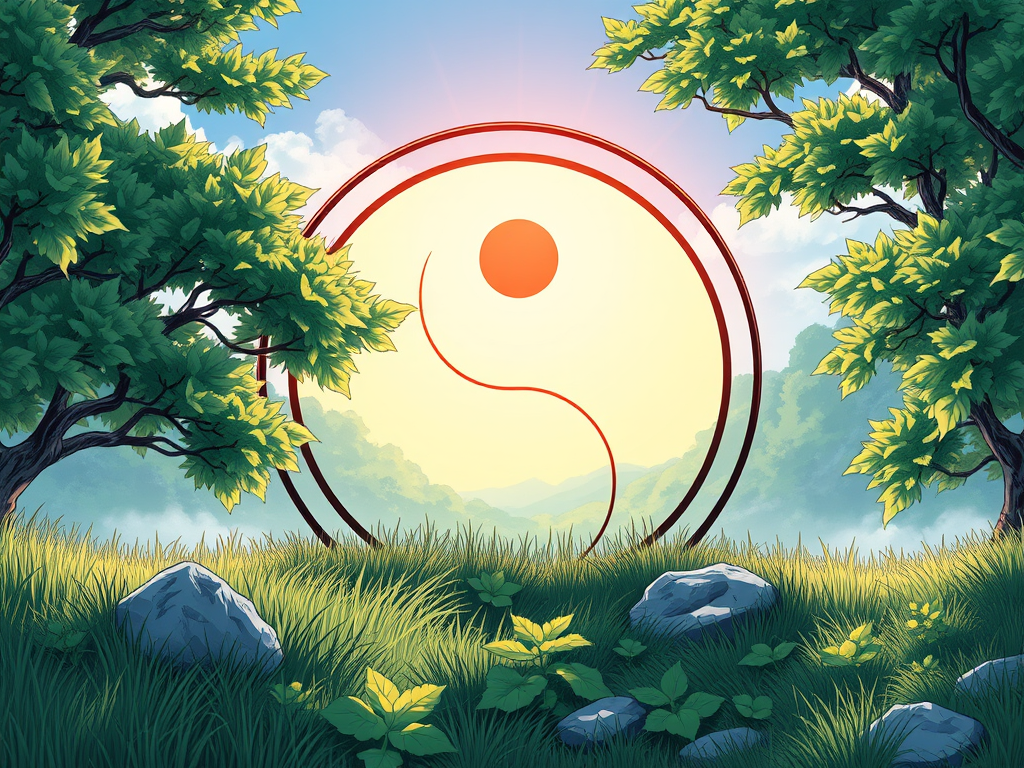
Taoism, an indigenous philosophical and religious tradition of China originating in the 6th century BCE, also offers a profound perspective on the unity of existence. Attributed to the semi-legendary sage Laozi, whose authorship is associated with the foundational text the Tao Te Ching, Taoism emphasizes living in harmony with the Tao (or Dao), often translated as “the Way”.
The central concept of Taoism is the Tao, which is understood as the ultimate, ineffable, and spontaneous principle underlying all reality. The Tao is not a personal god but rather the cosmic order, the source from which all things arise and to which they eventually return. It represents a fundamental unity that permeates and connects everything in the universe, transcending individual distinctions and separations.
A key principle in Taoism that reflects a non-dualistic understanding of duality is the concept of Yin and Yang. Yin and Yang are seen as two fundamental, opposing yet complementary forces that interact to create the ever-changing patterns of the universe. Yin is often associated with darkness, passivity, and the feminine, while Yang is associated with light, activity, and the masculine. Taoism teaches that these seemingly opposite forces are not in absolute conflict but are interdependent and essential for balance and harmony. This understanding that opposites are interconnected aspects of a unified whole aligns with the core tenets of non-duality.
Another important concept in Taoism is Wu Wei, often translated as “non-action” or “effortless action”. Wu Wei does not imply passivity but rather acting in accordance with the natural flow of the Tao, without forced effort or resistance. This principle suggests a way of being that transcends the dualistic tension between action and inaction, advocating for a spontaneous and natural engagement with the world.
Taoism also emphasizes the importance of naturalness (ziran) and simplicity. Living in accordance with nature and embracing simplicity are seen as ways to align with the inherent unity of the Tao and move beyond the artificial complexities and distinctions created by human thought. These values reflect a desire to return to a state of primordial unity and harmony with the universe.
The earliest Taoist texts, the Tao Te Ching (likely composed between the 4th and 3rd centuries BCE, although some scholars suggest earlier origins) and the Zhuangzi (also from the 4th-3rd centuries BCE), contain early expressions of these non-dualistic ideas. While the term “non-duality” itself might not be explicitly used in these texts, the core principles of the Tao as a unifying force, the interdependence of Yin and Yang, and the emphasis on naturalness and effortless action strongly resonate with non-dualistic philosophies. The Taoist worldview, centered on the inherent unity and interconnectedness of all things within the Tao, represents another ancient and significant expression of non-dualistic thought.
Taoism offers a profound nondual worldview. It comes closer than most traditions in terms of lived experience and conceptual fluidity but it cannot be strictly called nondual in the same metaphysical sense as Advaita Vedanta. The table below gives a breakdown of distinctions:
| Aspect | Taoism | Advaita Vedanta |
|---|---|---|
| Nature of Ultimate Reality | Tao is formless, spontaneous, and beyond conceptual grasp, but not explicitly consciousness. | Brahman is pure, actionless, infinite consciousness (chit). |
| Self and Realization | Taoism doesn’t speak of Ātman or Self-realization; the self is simply to be aligned with nature. | Realization is the direct knowledge that Ātman is Brahman—no second reality exists. |
| The World | The world is real and sacred as a manifestation of the Tao; not considered an illusion. | The world is ultimately unreal (mithyā), a projection of ignorance (avidyā). |
| Liberation Goal | Return to simplicity, spontaneity, harmony with the Tao—no strict notion of moksha or enlightenment. | Realization of nonduality and liberation (moksha) from birth-death cycle is central. |
In conclusion, Taoism is a functional, experiential, and poetic nonduality, but not a strict metaphysical nonduality like Advaita Vedanta. It invites harmony with the Whole, not identity as the Whole.
The Emanations of Unity: Non-Duality in Neoplatonism
Neoplatonism, a school of philosophy that flourished in the Greco-Roman world from the 3rd to the 7th century CE, represents a significant development in Western thought that incorporates non-dualistic concepts. Emerging as the dominant philosophical ideology of its time, Neoplatonism built upon the ideas of Plato, integrating elements of mysticism and religious thought.
At the heart of Neoplatonism is the concept of “The One,” the ultimate source of all reality, which is considered to be absolutely transcendent, indivisible, and beyond all categories of being and non-being. This “One” is not a personal god but rather the fundamental principle of unity from which everything else emanates in a hierarchical order. This emanation is not a process in time or space but a metaphysical unfolding, where each subsequent level of reality is a reflection or “shadow” of the level above it. The hierarchy typically includes the Intellect (Nous), which is the realm of thought and ideas, followed by the Soul, which animates the material world, and finally the physical universe itself.
The non-dual aspect of Neoplatonism lies in the understanding that despite the apparent multiplicity of these levels, they are all ultimately derived from and unified by “The One”. The material world, though the furthest emanation, is still connected to its source. Human beings, according to Neoplatonism, possess a soul that pre-exists their earthly life and is ultimately an emanation of “The One”. The goal of life is to achieve union with “The One” through contemplation, spiritual purification, and intellectual ascent, transcending the limitations of the material world and the individual self. This experience of unity is a direct, mystical encounter with the ultimate reality.
Key figures in Neoplatonism include Plotinus (3rd century CE), considered the founder of the school, whose teachings are compiled in the Enneads. His successors, such as Porphyry and Proclus, further developed and systematized Neoplatonic thought. Neoplatonism had a profound influence on Western philosophy, religion, and mysticism, including early Christian thinkers who sought to integrate its concepts with Christian theology.
Neoplatonism cannot be strictly called nondualistic in the same sense as Advaita Vedanta or certain schools of Mahayana Buddhism (like Dzogchen or Yogacara). While it does display some nondual tendencies, it ultimately preserves certain ontological distinctions that nondualism proper would dissolve. The following are the list of differences:
| Aspect | Neoplatonism | Advaita Vedanta |
|---|---|---|
| Ultimate Reality | The One (To Hen) – beyond being, thought, and all attributes | Brahman – nondual, attributeless (nirguna), infinite consciousness |
| Nature of Ultimate Reality | Transcendent and utterly simple; source of all, but distinct from all | Immanent and transcendent; all that exists is Brahman alone |
| Metaphysical Structure | Hierarchical: The One → Nous (Divine Mind) → World Soul → Matter | Apparent levels: Brahman (ultimate), Īshvara (personal God), Māyā (illusion) |
| Relation between Self and Ultimate | Soul can unite with the One through contemplation, but retains some distinction | Ātman is identical to Brahman – “Tat Tvam Asi” (You are That) |
| Cosmic Process | Emanation: All things flow from the One, gradually becoming less perfect | Superimposition (adhyāsa) via Māyā causes illusion of multiplicity |
| Path to Liberation | Intellectual and mystical ascent to the One via contemplation and purification | Self-inquiry (ātma-vichāra) and discrimination (viveka) lead to realization of Brahman |
| View on World | A necessary emanation; not evil, but progressively less real | Ultimately unreal (mithyā), a projection of ignorance (avidyā) |
| Final Realization | Union with the One (while some distinction may remain) | Realization that no distinction ever truly existed between self and Brahman |
Key Insight:
- Neoplatonism affirms unity with the One.
- Advaita Vedanta asserts there is only the One — no “with” remains.
The Heart’s Knowing: Non-Duality in Christian Mysticism

While mainstream Christianity often emphasises a distinction between God and creation, a rich tradition of Christian mysticism explores the concept of non-duality, highlighting the intimate and inherent connection between the divine and the created world. This perspective suggests that God and creation are not entirely separate but rather deeply intertwined, with the divine presence immanent within all things.
Christian non-duality often draws upon biblical passages that speak to the unity of God and humanity, such as Jesus’s prayer in John 17:21-23 that his followers “may all be one, just as you, Father, are in me, and I in you, that they also may be in us… that they may be one even as we are one, I in them and you in me, that they may become perfectly one.” Mystics within the Christian tradition have interpreted the Incarnation, where God became human in Jesus Christ, as a profound expression of this inherent unity.
Key themes in Christian non-duality include the experience of oneness with God, the realisation that the individual self is not separate from the divine, and the understanding that the Kingdom of God is not a distant realm but is present here and now. This perspective often involves a shift in perception from a dualistic worldview, which divides reality into separate categories, to a non-dual awareness that perceives the underlying unity of all existence.
Influential figures in Christian mysticism who have explored non-dualistic themes include Meister Eckhart (13th-14th century), Julian of Norwich (14th-15th century), and more contemporary thinkers like Thomas Merton, Richard Rohr, and Cynthia Bourgeault. These mystics often emphasise the importance of contemplative practices, such as centring prayer and meditation, to cultivate a direct, experiential understanding of this non-dual reality. While the term “non-duality” is more commonly associated with Eastern traditions, these Christian mystics articulate a similar understanding of the fundamental interconnectedness of God and creation, and the potential for direct union with the divine.
Though some Christian Mystics, as noted above, speak in a language similar to nonduality of Advaita there are some key differences which are encapsulated in the table below
| Dimension | Christian Mysticism | Advaita Vedanta |
|---|---|---|
| Ontology | God and creation are distinct but intimately united. Even in mystical union, God remains “other.” | All distinctions are ultimately illusory. Only Brahman exists; the world is mithyā (apparent). |
| Theology | Creator–creature distinction remains foundational. Union is relational, not ontological identity. | Ātman is identical with Brahman. There is no second reality (advaita = “not two”). |
| Incarnation | God becomes human (Christ) in time—seen as a joining of divine and human natures. | No such “joining” needed; the Self has always been Brahman, merely covered by ignorance. |
| Language of God | Personal God (theistic language) persists, even in mysticism. | Ultimate reality is impersonal, attributeless (nirguna). Personal God is provisional. |
In conclusion, Christian mysticism approaches nondual awareness experientially, but it usually retains theological dualisms—most importantly, that God is still ontologically “other,” even if mystically united with. Thus, Christian nonduality is often relational and participatory, while Advaita is ontological and non-relational.
We might call Christian nonduality “soft nondualism” or “relational nonduality”, but not strict nondualism in the Advaitic sense.
Fana and the Flame: A Journey into Nondual Sufi Mysticism
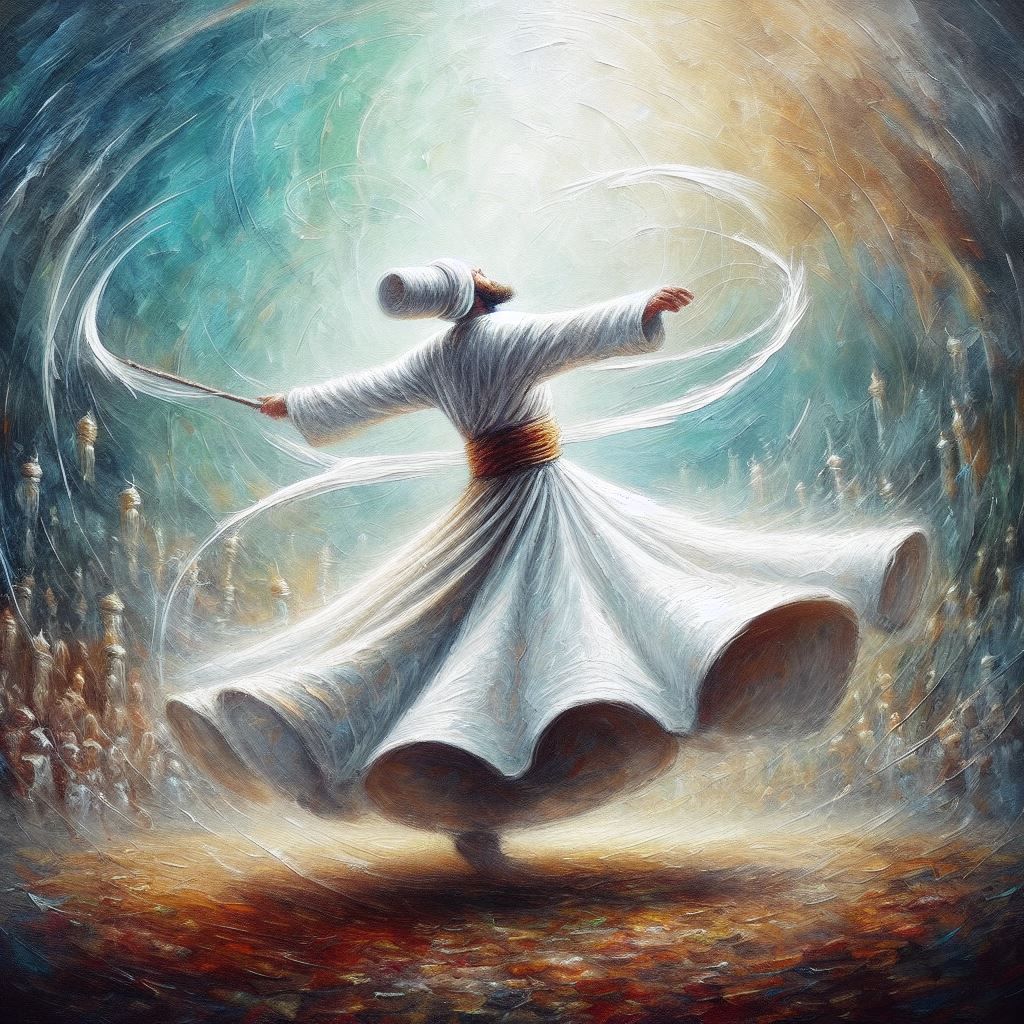
Sufism, the mystical branch of Islam, also presents a profound understanding of non-duality, emphasizing the absolute oneness of God (Allah) and the illusory nature of separation between the individual and the Divine. The central tenet of Islam, Tawhid, which signifies the absolute unity of God, is interpreted by Sufis as an existential call to recognize the non-dual nature of reality.
A key concept in Sufi non-duality is Wahdat al-Wujud (Unity of Being), a philosophical doctrine popularized by the influential mystic Ibn Arabi (1165-1240 CE). This doctrine posits that there is only one true Being, which is God, and that all other existence is merely a manifestation or appearance of this singular reality. The perceived separation between the Creator and the creation is seen as an illusion created by the limitations of the human mind.
Sufis emphasize the importance of transcending the ego and the dualistic mind to experience the direct reality of God’s oneness. This is often achieved through various spiritual practices, including dhikr (remembrance of God), meditation, music, and poetry, which aim to purify the heart and facilitate a direct encounter with the Divine. The ultimate goal in Sufism is often described as fana (annihilation), a state of complete self-effacement and union with God, where the individual’s separate existence dissolves in the ocean of divine oneness.
Prominent Sufi mystics who have articulated non-dualistic ideas include Rumi (13th century), Attar of Nishapur (12th century), and Al-Ghazali (11th century). Their poetry and teachings often speak of the all-encompassing nature of divine love and the realization that “there is nothing but God”. Sufism, with its rich tradition of mystical experience and its emphasis on the underlying unity of all existence in God, represents a significant expression of non-dual thought within the Abrahamic traditions.
Sufi mysticism—especially in the form of Wahdat al-Wujūd (Unity of Being)—comes much closer to strict nonduality than Christian mysticism or Neoplatonism. Wahdat al-Wujūd and fana—represents a strong form of experiential nonduality that approaches Advaita very closely. In fact, among the Abrahamic traditions, Sufism is the closest analogue to Advaita, but it still does not fully align with Advaita Vedanta’s strict nondualism.
Here’s a careful analysis:
| Aspect | Sufi Mysticism | Advaita Vedanta |
|---|---|---|
| Ontology of God | God is absolutely One, but is still described as personal, willful, and distinct in some way. | Brahman is impersonal, nirguna (without qualities), not a “being” but pure awareness. |
| Persistence of Theism | Even in fana, the language of lover and Beloved, servant and Lord often persists (though it dissolves temporarily). | Realization is of identity: Ātman is not other than Brahman. No “relationship” remains. |
| Post-Fana Perspective | The mystic often returns with a renewed love of God and creation (baqa), retaining reverence for God’s transcendence. | After realization, the dualistic world is seen as illusory or a projection of ignorance. There is no “return” as such. |
In conclusion, ontologically Sufism retains a theistic core: God is One, but not equated with the self in the way Advaita equates Ātman with Brahman. So while it is functionally and experientially nondual, it is not strictly nondual in the metaphysical sense Advaita demands.
Upanishads: The Origin That Needs No Origin
There is no dissolution, no creation, no one bound, no one seeking, no one desiring liberation, and no one liberated. This is the absolute truth.”
— Mandukya Karika, II.32
To read the Upanishads is not merely to study ancient philosophy; it is to stand at the source of a stream that has fed centuries of spiritual inquiry. Their voice is not loud, but it is exact. They do not argue—they reveal. In an age crowded with systems, practices, and promises of transcendence, the Upanishads remain radical in their simplicity: you are not part of the whole—you are the whole.
In tracing the arc of nondual thought across traditions, we return full circle to the earliest articulations of it. Not to diminish what came after, but to recognize that some truths arrive whole, not as a conclusion, but as a beginning. The Upanishads are such a beginning—still, after all this time, astonishingly complete.

 Neev Community for Self Inquiry & Sustainability