
A Short YouTube Video Based on the Article
The following YouTube video is a short summary of the contents of this article. Those interested in a deeper dive should definitely proceed to the article after going through the video!
The Paradox of Progress
Have you ever wondered why, despite inhabiting the most technologically advanced age in human history, we are more restless, lonely, and anxious than ever before? Our homes glow brighter than ancient palaces, our tables overflow with commodities unimaginable to our ancestors — and yet the World Health Organization reports rising levels of depression and anxiety across the globe.¹ This is the central paradox of modernity: unprecedented material abundance has not translated into psychological peace.
Sociologists sometimes explain this as anomie, the breakdown of meaningful norms and bonds in modern societies.² But the phenomenon reaches deeper than any single term can capture. It is the outcome of profound trade-offs embedded in humanity’s trajectory — the displacement of older ways of living and knowing, in exchange for the comforts of industrial civilization.
Philosophers across cultures have long anticipated this paradox. The Buddha reminded us that no worldly attainment can extinguish duḥkha — the subtle dissatisfaction woven into existence itself.³ The Greek Stoics insisted that wealth and power cannot guarantee ataraxia, the serenity of soul that comes only by mastering one’s inner responses.⁴ And Śaṅkara, the great Advaitin, declared that true liberation (mokṣa) lies not in possessions but in the recognition that the Self (ātman) is none other than the limitless reality (Brahman).⁵ These traditions, distinct as they are, converge on one luminous insight: genuine peace arises not from external acquisitions but from the discovery of an inner dimension that transcends circumstance.
The Wild: A Closer Look at Hunter-Gatherer Life
If we compress human history into a single year, humanity lived as hunter-gatherers for over eleven months. Agriculture, industry, and modern states occupy only the final days of that metaphorical year. This means that the architecture of our minds and bodies was sculpted not in cities but in forests, plains, and rivers.
Anthropologist Marshall Sahlins described these societies as the “original affluent societies” — not because they hoarded wealth, but because they met their needs with relative ease and enjoyed more leisure than early agriculturalists.⁶ Their affluence lay not in accumulation, but in sufficiency.
Of course, this world was not utopia. High infant mortality, disease, and vulnerability to the elements were ever-present realities. Yet even with these challenges, hunter-gatherer life embodied profound forms of freedom. Their societies were remarkably egalitarian: mobility discouraged hoarding, and food-sharing was a cultural glue.⁷ The community was not a set of individuals bound by contracts, but a living organism where each depended on and enriched the other.
The community was not conceived as a loose collection of self-interested individuals bound by contracts, as later social theories would imagine, but as a living organism whose vitality emerged from webs of reciprocity, trust, and interdependence. Each member was less an autonomous unit and more a vital organ in a larger body, whose health depended upon the free circulation of care, resources, and recognition. Among hunter-gatherers, the gift of food was not merely caloric transfer but the ritual reaffirmation of belonging — each portion of meat, each gathered berry, carrying with it the unspoken message: you are part of us, and we are part of you.
This relational fabric was sustained not by codified law or written contract but by story, memory, and the immediacy of face-to-face encounter. The hunter who returned from the forest was sustained by the laughter of children; the elder’s wisdom, in turn, was nourished by the attentive ears of the young. Personhood itself was porous, always in relation, always a node in the greater weave. The “self” was never merely the body or mind of an individual, but the echo of countless exchanges — with the land, with ancestors, with the shifting circle of kin.
Anthropologists like Marcel Mauss have shown that the gift economy was not reducible to barter but carried with it obligations of gratitude and solidarity, weaving ties of mutual recognition that made survival not only possible but meaningful.⁸ James Woodburn has described this as an “immediate-return society,” in which hoarding was impractical, and the very act of sharing prevented the crystallization of hierarchy.⁹ In such a lifeworld, autonomy was not negated but transfigured, for freedom meant not isolation but the ability to give and receive without fear, to live in trust of the larger whole.
Thus, community was not an external arrangement superimposed upon individuals, but the very condition of their existence — a sacred ecology of persons in which survival and celebration, necessity and reverence, were indivisible.
Equally significant was their cosmology. Jerry Mander emphasizes that such cultures did not view nature as inert matter but as a sacred presence.¹⁰ The river was not simply water; it was life, story, and spirit. The forest was not an obstacle but a home, a teacher, a text of meaning to be read with reverence. To dismiss such peoples as “primitive” is to betray a failure of imagination — to overlook the philosophical depth encoded in their lifeways, their myths, their rituals, their silences.
The hunter-gatherer, sitting before the fire, did not divide cosmos into spirit and matter, sacred and profane, subject and object. Their cosmology was an ontology of relation, in which stones could speak, rivers could remember, and animals could enter into kinship. Such a vision is not naïve animism but a profound refusal of reductionism, a recognition that the human is never autonomous but always entangled with what surrounds it. Philosophers of ecology in our own time — from Arne Naess’s deep ecology to Bruno Latour’s actor-network theory — are only rediscovering, with scholarly apparatus, what these so-called “primitives” lived as common sense.¹¹
To trivialize their world as a stage humanity has “outgrown” is to ignore the possibility that they embodied modes of thought we urgently need: an ethics of enough, an epistemology of attention, a metaphysics of reciprocity. They may not have left behind treatises or systems of logic, but they transmitted their philosophy in song, gesture, and seasonal ritual, encoding truths about being that rival the most intricate metaphysical speculations of later ages.
Thus, to call them “primitive” is not merely inaccurate — it is a form of blindness. For beneath their simplicity lies a contemplative depth, a lived phenomenology of oneness, which modernity, in its haste, has largely forgotten. To approach them with reverence rather than dismissal is to recover another chapter of humanity’s philosophical inheritance, one written not in ink, but in earth, fire, and breath.
From this vantage, the modern condition begins to look less like a natural culmination and more like a dislocation. We have exchanged lightness for burden, reciprocity for exploitation, reverence for commodification. No wonder the psyche strains under the weight of this exchange.
The Rise of Civilization and the Weight of Order
The shift to agriculture was neither a sudden fall from grace nor a straightforward ascent into progress. It was a tangled transformation that reshaped every aspect of human life. Agriculture produced surpluses, enabling population growth, settled communities, and the flowering of art and philosophy. But it also introduced hierarchy, inequality, and the consolidation of power.¹²
As human settlements grew, rituals once organic to communal life hardened into codified systems. In Vedic India, yajña (sacrifice) evolved from a cosmic celebration into an increasingly intricate performance.¹³ These rituals carried profound meaning, but they also centralized power in the hands of a priestly elite. The chants of the Brahmins preserved sacred knowledge, yet they often veiled it beneath labyrinthine formalities.
The sociologist Max Weber described this process as rationalization: the drive toward efficiency, calculability, and order that eventually strips the world of enchantment.¹⁴ What began as sacred fire became, over centuries, an administrative mechanism of duty and hierarchy. What was once alive with mystery risked becoming suffocating in its precision.
This is not unique to India. Across civilizations, ritual and hierarchy grew alongside wealth and power, binding societies together but also constraining the individual spirit. The cost of order was often the eclipse of wonder.
The Wise: The Forest as Philosophy
Yet, the human longing for deeper freedom could not be contained. Some turned away from the courts of kings and the liturgies of priests, seeking truth in the silence of forests. The śramaṇas — wandering seekers — embodied this turn.¹⁵ They were not rejecting civilization wholesale, but interrogating its claims and limits.
This same impulse shaped the internal evolution of the Vedic tradition itself. The vast corpus of Vedic ritual literature — the Saṃhitās and Brāhmaṇas — elaborated complex sacrifices to maintain cosmic order (ṛta) and secure worldly and heavenly goods. But even within this framework, a sense arose that ritual precision alone could not exhaust humanity’s spiritual hunger. Certain portions of the Brāhmaṇas, composed for those who retired to the forest, came to be called Āraṇyakas (“forest texts”).¹⁶ These were not manuals of renunciation, but transitional writings — still ritualistic, yet already gesturing beyond external action toward inner meditation. The sacrifice was no longer only an outward performance; it became interiorized, reimagined as a contemplative act within consciousness itself.
From this liminal zone the Upaniṣads emerged. If the Saṃhitās were hymns of praise and the Brāhmaṇas were guides of ritual, the Āraṇyakas were thresholds. And the Upaniṣads, literally “sittings near” a teacher, crossed that threshold into open metaphysics. They preserved the forest atmosphere of withdrawal and inquiry, but now the central concern was not the mechanics of sacrifice, but the ultimate identity of self (ātman) and absolute (brahman). The question shifted from how to perform rightly to what is real, what is the Self, what endures when all rites are done.
In this way, the śramaṇa spirit and the Vedic inheritance converged. Out of the tension between ritual order and forest freedom arose a literature of profound inquiry — the Upaniṣads — where the whisper of leaves and the silence of meditation became the true sacrificial fire. The Upaniṣadic sages were heirs to this movement. They asked not how to secure prosperity or power, but what lies at the root of consciousness itself.¹⁷
Their discoveries reshaped the very axis of Indian thought. Tat Tvam Asi (“Thou art That”), Aham Brahmāsmi (“I am Brahman”), and other declarations were not mere metaphysical speculations; they were direct challenges to the structures of ritual and hierarchy.¹⁸ They revealed that ultimate reality was not mediated by priests or kings, but accessible within the heart of every being.
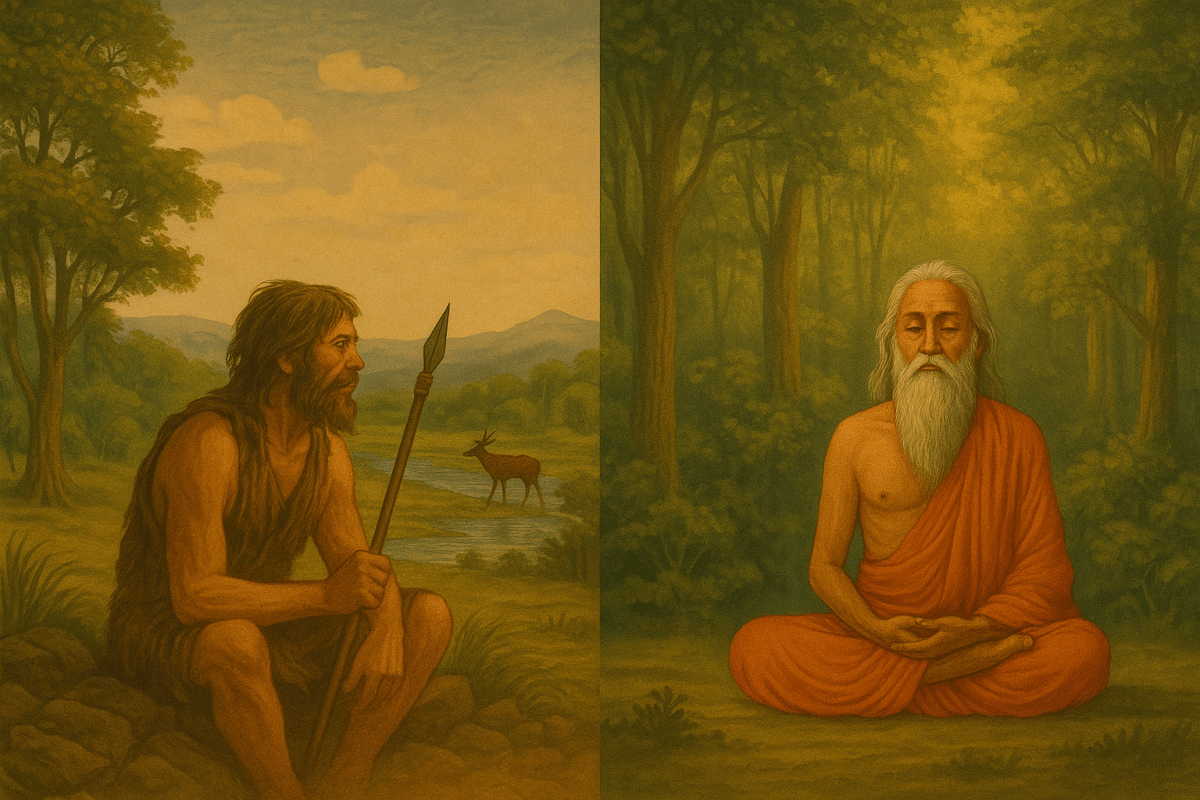
The outward hunt of the forager became an inward search for the Self. The gathering of fruits became a gathering of insights. Here the “wild” and the “wise” converged: simplicity of life intertwined with profundity of thought, producing a vision of freedom that was both ecological and existential.
The Modern Eclipse
With the industrial revolution, humanity entered a new chapter. Machines multiplied productivity, but they also accelerated alienation — from labor, from community, and from the Earth itself.¹⁹ Cities grew denser, yet relationships grew thinner. Nature, once seen as sacred, became raw material for extraction.
Jerry Mander insists that technology is never neutral. Every tool reshapes perception, values, and social structures.²⁰ Television, for example, does not merely broadcast content; it alters how communities imagine themselves, replacing lived culture with corporate imagery. Industrial systems centralize power, hollow out local autonomy, and seduce societies into cycles of dependency.
From an Advaitic standpoint — especially Gaudapāda’s doctrine of ajātivāda (non-origination) — even this eclipse is not final.²¹ Civilizations rise and fall like dream-images; technologies dazzle and collapse, but the Self, unborn and undying, remains untouched. To realize this is to pierce through both despair and utopia. Yet, from a relative standpoint, the crisis is undeniable: ecological collapse, climate chaos, and psychic fragmentation press upon us with increasing urgency.²²
And here the vyāvahārika and the pāramārthika meet. For though the Self needs no conditions for its realization — it is ever-present, self-luminous — the seeker does. The adhikārī must have a mind sufficiently still, and a life sufficiently unburdened, to turn inward. A society driven by relentless consumption and precarity corrodes the very conditions for such inquiry. If one is perpetually anxious about survival, coerced into endless labor, or estranged from the rhythms of nature, how can one cultivate the leisure (śamā) and inner quietude (upaśama) that the Upaniṣads extol as prerequisites for knowledge?²³
This is why the ancient sages, even within the Vedic fold, sought refuge in the forests. The Āraṇyakas were not merely texts of ritual performed away from the village; they signified a mode of life where withdrawal created the space for reflection. In the hush of the forest, free from the incessant demands of the court and the marketplace, a new questioning was born: not what ritual secures heaven, but what is the Self that outlasts both heaven and earth. Out of such retreats the Upaniṣads emerged, their wisdom inseparable from the quietude of place.²⁴
Today, we cannot always flee to the forest. Yet, capitalism’s totalizing grip makes the creation of new “forests” urgent — not merely geographical, but social and psychological. Communities of simplicity, ecological sanctuaries, and intentional spaces of sufficiency can play the role that the forest once did: loosening the clutch of desire, releasing the seeker from the treadmill of endless productivity, and allowing silence to speak. Without such counter-spaces, self-inquiry risks being suffocated by the noise of the market and the tyranny of survival.
Thus, the task of reimagining our relation to ecology and economy is not a distraction from Advaita but its necessary prelude. To build forests — whether of trees or of stillness — is to clear the ground for the realization that the Self has never been bound.
The Fusion: A Path of Integration
If the hunter-gatherer embodied the outer freedom of living lightly upon the earth, and the sage of the Upaniṣads embodied the inner freedom of awakening to the Self, then our age requires a conscious weaving of the two. Neither nostalgia for a vanished past nor blind acceleration into technological futures will suffice. What is needed is a fusion — not a patchwork compromise, but an organic integration of the wild and the wise.
From the hunter-gatherer world we inherit a vision of sufficiency: that human flourishing is not measured by accumulation, but by the depth of bonds, the ease of sharing, and the reverence for the more-than-human world. Their cosmologies remind us that rivers, forests, and skies are not “resources” but living presences — partners in existence, not commodities for extraction.²⁵
From the Upaniṣadic sages we inherit the radical discovery that the Self (ātman) is not a fragment of the world but the limitless ground (Brahman) in which world and self alike appear. Their message dissolves hierarchies: kings and beggars alike are but expressions of the one consciousness. Liberation lies not in possession, but in the recognition that one is never bound.²⁶
Together, these streams converge into a double freedom: ecological and existential. Outer freedom — simplicity, sufficiency, and reciprocity with the earth. Inner freedom — detachment from illusion, realization of the Self, and equanimity amid change. The wild teaches us to walk gently; the wise teaches us to see deeply.
This fusion is not hypothetical. It already whispers in eco-villages, permaculture movements, intentional communities, and contemplative retreats where sustainability and self-inquiry intertwine. When people plant gardens while studying the Upaniṣads, or craft tools with their hands while practicing śravaṇa and nididhyāsana, they are not merely experimenting — they are rediscovering a mode of life that the human story has always gestured toward.
Jerry Mander warned that without the sacred, sustainability degenerates into mere managerial jargon.²⁷ Advaita extends the point: the sacred is not an optional addition, but the essence of reality itself. What seems “lost” is only obscured by ignorance; what seems “distant” is none other than the Self. To awaken to this is to see that the wild and the wise are not two paths awaiting reconciliation, but two faces of the one truth — ecological reverence and metaphysical realization, earth and spirit, sufficiency and liberation.
The way ahead is not regression but renewal. By fusing the humility of the forager with the insight of the sage, we may yet find a passage through crisis — a life at once lighter upon the earth and deeper within the Self.
References
- World Health Organization. Depression and Other Common Mental Disorders: Global Health Estimates. WHO, 2017.
- Durkheim, Émile. Suicide: A Study in Sociology. 1897.
- Rahula, Walpola. What the Buddha Taught. Grove Press, 1974.
- Epictetus. Discourses and Selected Writings. Trans. Robert Dobbin. Penguin Classics, 2008.
- Śaṅkara. Vivekacūḍāmaṇi. Trans. Swami Madhavananda. Advaita Ashrama, 1921.
- Sahlins, Marshall. Stone Age Economics. Aldine-Atherton, 1972.
- Lee, Richard B., and Irven DeVore, eds. Man the Hunter. Aldine, 1968.
- Mauss, Marcel. The Gift: Forms and Functions of Exchange in Archaic Societies. 1925.
- Woodburn, James. “Egalitarian Societies.” Man 17, no. 3 (1982): 431–451.
- Mander, Jerry. In the Absence of the Sacred. Sierra Club Books, 1991.
- Latour, Bruno. We Have Never Been Modern. Harvard University Press, 1993.
- Scott, James C. Against the Grain: A Deep History of the Earliest States. Yale University Press, 2017.
- Staal, Frits. Agni: The Vedic Ritual of the Fire Altar. Asian Humanities Press, 1983.
- Weber, Max. The Sociology of Religion. 1920.
- Bronkhorst, Johannes. Greater Magadha: Studies in the Culture of Early India. Brill, 200
- Hume, Robert Ernest. The Thirteen Principal Upanishads. Oxford: Clarendon Press, 1921.
- Olivelle, Patrick. The Early Upaniṣads: Annotated Text and Translation. Oxford: Oxford University Press, 1998.
- Radhakrishnan, Sarvepalli, and Charles A. Moore, eds. The Principal Upaniṣads. London: George Allen & Unwin, 1953.
- Marx, Karl. Economic and Philosophic Manuscripts of 1844. Moscow: Progress Publishers (English edn.), 1959.
- Mander, Jerry. Four Arguments for the Elimination of Television. New York: William Morrow, 1978.
- Gaudapāda. Māṇḍūkya Kārikā with Śaṅkara’s commentary. Translated by Swami Nikhilananda. New York: Ramakrishna-Vivekananda Center, 1949.
- Loy, David. Nonduality: A Study in Comparative Philosophy. Amherst, NY: Humanity Books, 1997.
- Śaṅkara. Vivekacūḍāmaṇi (The Crest-Jewel of Discrimination). Translated by Swami Madhavananda. Kolkata: Advaita Ashrama, 1921.
- Olivelle, Patrick. The Āśrama System: The History and Hermeneutics of a Religious Institution. Oxford: Oxford University Press, 1993.
- Sahlins, Marshall. Stone Age Economics. Chicago: Aldine-Atherton, 1972.
- Radhakrishnan, Sarvepalli. The Principal Upaniṣads (alternate editions: Harper & Row / Allen & Unwin — 1953).
- Mander, Jerry. In the Absence of the Sacred: The Failure of Technology and the Survival of the Indian Nations. San Francisco: Sierra Club Books, 1991.


