Categories
Advaitic Inquiries Comparative Advaita

Do Advaita and Buddhism Point to the Same Truth?

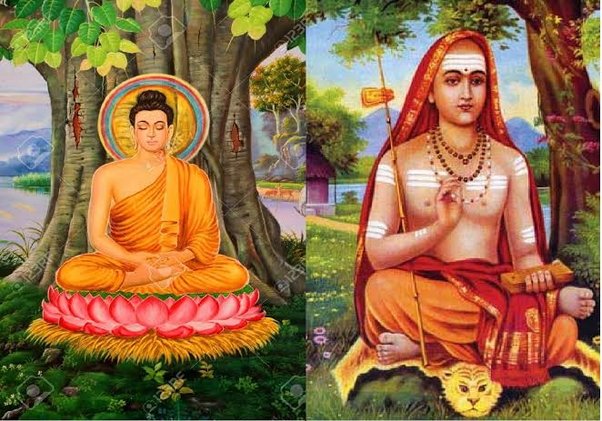
This blog explores whether Advaita Vedānta and Buddhism ultimately point to the same truth. Through a thoughtful dialogue, it traces the meeting ground between Nāgārjuna’s emptiness (śūnyatā) and Gaudapāda’s non-origination (ajāti). Both dissolve all dualities—self and other, subject and object—revealing an unborn reality beyond thought. Yet a tension remains: Buddhism denies any enduring consciousness, while Advaita proclaims consciousness alone as the timeless reality.

As the conversation deepens, these apparent opposites begin to merge. When both experiencer and experienced vanish, is “emptiness” truly different from “consciousness”? The article suggests that Gaudapāda, writing before sectarian walls were built, may have seen the essential convergence between these paths.

Ultimately, this piece—arising from a dialogue with Claude AI—reflects the timeless exchange between Buddhist and Advaitin inquiry, showing how both, when followed to their limit, dissolve into the same wordless recognition of non-dual truth beyond affirmation or negation.
Categories
Advaitic Inquiries

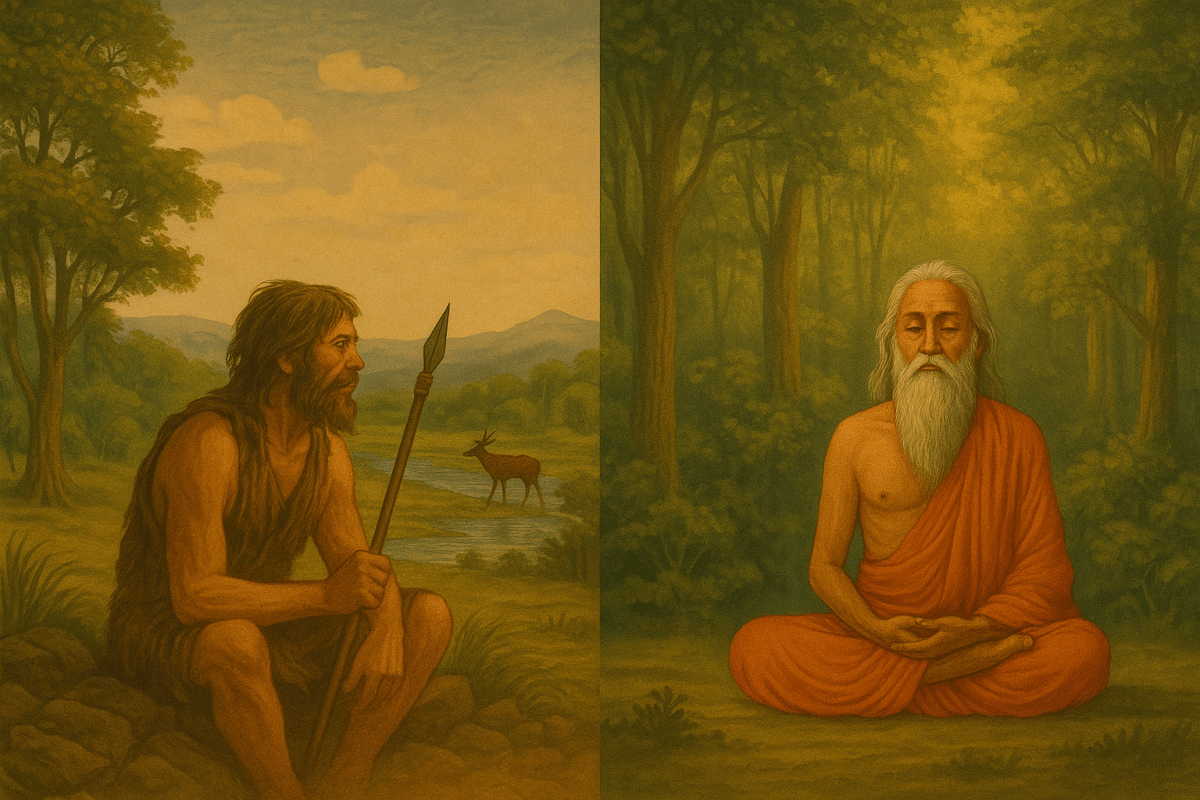
The Wild and the Wise: Finding a Path for Our Anxious World

Despite inhabiting the most technologically advanced age in human history, we are more restless, lonely, and anxious than ever before.

This article traces the deep resonance between the hunter-gatherer’s way of living lightly upon the earth and the Upanishadic seer’s awakening to the boundless Self. Early humans moved with reverence through forests, rivers, and skies, while the Vedic sages themselves withdrew into the forests to seek the eternal truth beyond birth and death. But with the rise of industrial civilization, humanity drifted from both — trading simplicity for consumption, and inner freedom for restless striving.

The way forward is to weave these two great streams together: the outer simplicity of the forager and the inner realization of the sage. In their fusion lies a path toward wholeness, sustainability, and true freedom.

Categories
History of Advaita

The Value of Shankara in the Tradition of Advaita – As a Philosopher or Commentator?

The tradition of Advaita Vedanta as a means of liberation is synonymous with the name of Shankara, not because, as many people erroneously believe, he was it’s founder, instead, Shankara’s fame and his legendary status in the annals of Advaita Vedanta are for reasons more complex, which I shall be exploring in this article. I am going to examine whether the main contribution of Shankara was really as an original philosopher who propounded new ideas, or, was his essential contribution more as an Upanishadic theologian, scholar, commentator and interpreter? I shall also examine other historical factors that led to the legendary status reserved for Shankara today, which may not have all to do with his scholarly skills.

Categories
Advaitic Inquiries

Samsara is Nirvana – The Perfection of the Imperfection

Social media feeds feel like storm warnings—flashing red, relentless. In every scroll, 2025 is cast as a cursed year. It’s easy to feel buried under the nonstop flood of headlines and social media updates. The news can stir up strong emotions—worry, anger, frustration, dread—and it’s easy to get caught in thoughts about how wrong things are or how they should be different. The world can seem more terrifying than ever. However, the view of the world is different for those who have non-dual vision.

Using very simple analysis, in this article, I want to explore this paradoxical clarity of enlightenment—a state of mind that perceives perfection and wholeness even in the apparent imperfection and chaos of the world with the hope that such an exploration can inspire people to seek the same vision and ultimately free themselves from suffering.

Categories
History of Advaita

The Upanishads and the Axial Age: Rigvedic People – Invaders, Immigrants or Indigenous? – Part 3

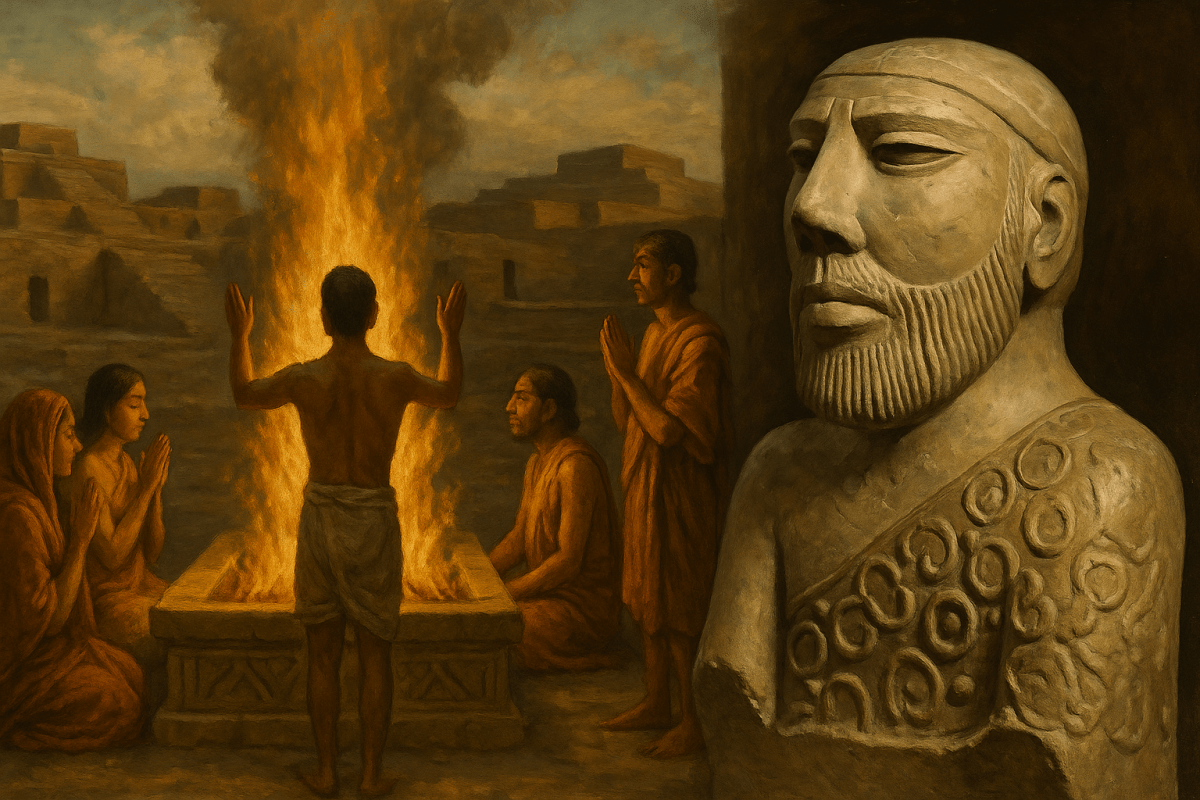
For generations, ancient India’s narrative was dominated by the Aryan Invasion Theory (AIT), later refined as Aryan Migration Theory (AMT). These 19th-century theories depicted external “Aryans” arriving around 1500 BCE, bringing Vedic traditions and Sanskrit, supposedly subjugating the indigenous Harappans. This framework, the article argues, became a potent political tool, fostering a divisive “Aryan-Dravidian” split and undermining Indian heritage.

However, the Out of India Theory (OIT) offers a compelling counter-narrative: the Indo-Aryan people and their Vedic culture originated within India, with the Indus Valley Civilization (IVC) being the Vedic Civilization. OIT proponents cite the absence of invasion evidence at Harappan sites, highlighting profound cultural continuity. New archaeological and genetic findings increasingly support indigenous origins, even suggesting westward migrations from India.

This isn’t just an academic debate; it’s a vital quest to “reclaim India’s national identity.” By challenging ingrained historical distortions, OIT aims to re-establish India’s place as a “Cradle of Civilization,” predating Mesopotamia and Egypt, affirming a deep, unbroken cultural lineage.

Categories
Advaitic Inquiries

What Does It Mean To Be Enlightened?

This post is a response to a question from a friend who’s seriously exploring what enlightenment actually is. It’s a good question — and a rare one — because most people, like I did for fifteen years, chase enlightenment as if it’s some mystical high, a state of bliss, or a mind-blowing shift in consciousness.

But here, I’m cutting through all that.

No poetry. No metaphors. No smoke and mirrors.

I’m answering the question head-on — in plain, precise language that doesn’t flinch and doesn’t hide behind spiritual jargon. And what I offer here stands up to every form of rational scrutiny.

If you’re looking for clarity, not fantasy, this is for you.

Categories
History of Advaita

The Upanishads and the Axial Age: Religion in Pre-Historic India – Part 2

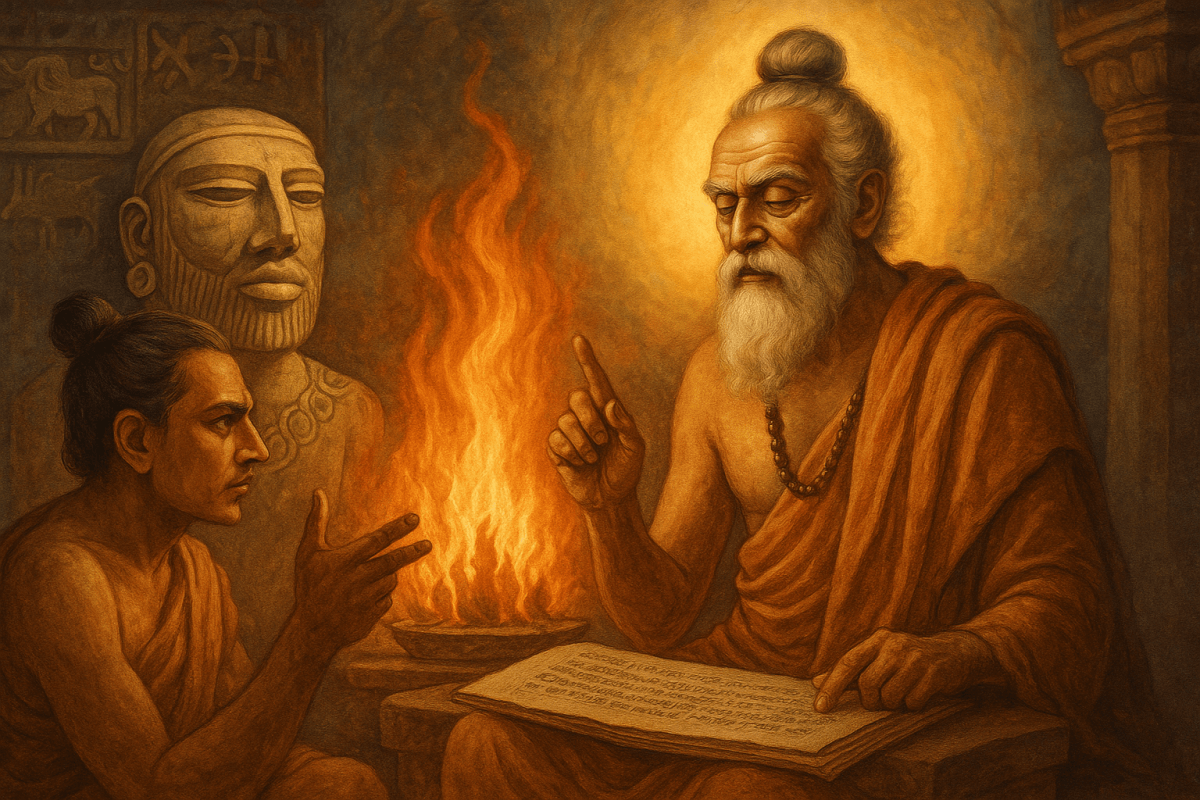
In Part 1 of this series, I traced the quiet birth of the Upanishadic vision against the backdrop of one of humanity’s great turning points—the Axial Age. In Part 2, the focus turns to the Indian subcontinent itself—not yet Vedic, but already in motion. I will trace the social, political, and religious changes unfolding in pre-historic and proto-historic India, which together form the cultural soil from which later Vedic and eventually Upanishadic thought would emerge. I also show that evidence increasingly points to a profound continuity between the Harappan (Indus-Sarasvati) civilisation and later Indian culture, suggesting the Harappans themselves may have been the authors of the Rigvedic tradition that gave rise to the Upanishads.

Categories
History of Advaita

The Upanishads and the Axial Age: From Sacred Fire to Inner Light – Part 1

In an age when old rituals faltered under the weight of expanding empires, urban complexity, and moral uncertainty, a quiet revolution unfolded in the forests of ancient India. The Upanishads, composed between 800 and 200 BCE, did not merely extend the Vedic tradition—they dismantled its core assumptions. Sacrifice gave way to self-inquiry. The gods of the altar were replaced by the questioner within.

This shift wasn’t isolated. Across Eurasia, from Greece to China, prophets and philosophers began asking not what to worship, but how to live. The German philosopher Karl Jaspers called it the Axial Age—a spiritual pivot in world history. The Upanishads are India’s profound answer to that moment. Where others turned outward to law, ethics, or reason, India turned inward—seeking the divine not in temples or sacrifices, but in consciousness itself.

This article argues that the Upanishads are more than scripture; they are a civilizational rebirth. In Part 1, we map the Axial Age across cultures. In Part 2, we enter the Indian mind, where the fire of ritual became the light of introspection—and where the self (Ātman) was revealed to be not separate from, but identical with, ultimate reality (Brahman).

Categories
Advaitic Inquiries

When The Elephant Vanishes: Seeing Through Maya

In the timeless tradition of Advaita Vedanta, the pursuit of truth begins with a radical inquiry: Is what I perceive truly what is? This blog, based on an insightful article by Vivek, a member of the NEEV Community for Self-Inquiry and Sustainability, explores this very question through a powerful allegory—the story of a wooden elephant mistaken for the real.

At the heart of this reflection lies the fundamental Advaitic principle of adhyāsa, or superimposition. The root problem of human suffering is the superimposition (adhyāsa) of the non-Self (body, mind, world) upon the Self (pure consciousness), and vice versa. Just as one mistakes a rope for a snake or a wooden elephant for a real one, so too does the ignorant mind mistake the transient world/non-Self for ultimate reality/Self.

Categories
Advaitic Inquiries

The War on Joy: How Society Conditions You to Stay Unhappy & How To Break Free

In every civilization, power structures have evolved to control the masses. While in the past, these structures relied on brute force—kings, empires, and oppressive regimes—today’s world operates on far subtler mechanisms. The modern system does not use whips or shackles; instead, it binds the human mind through psychological chains, ensuring that people remain trapped in dissatisfaction, fear, and endless pursuit of external validation. By challenging the foundations of the modern system and offering an alternative rooted in self-inquiry, member of NEEV Community for Self Inquiry and Sustainability, Vivek provides more than just a critique—he offers a path to liberation. This article is not merely an analysis; it is a call to reclaim our joy, our freedom, and our very being.

Categories
Advaitic Inquiries Pre-Witness Stage

Advaita, Capitalism And The Red Pill Of Truth

In this post I talk about why the understanding of Capitalism and uprooting it from one’s life psychologically and physically is essential for the study of Advaita and attaining it’s goal of liberation, especially for householder Advaitins.

Categories
Comparative Advaita

Ignorance, Liberation and Non-Duality in Advaita and Theravada Buddhism – Part 1

Introduction Advaita and Buddhism are two non-dual paths that talk about liberation from suffering. Theravada Buddhism is a school of Buddhism that claims to be based on the original Pali transmission of the Buddha. In this article, I am examining both these paths through quotes and explanations to illustrate what they mean by liberation, what […]

Categories
Meditative Inquiries

Observing the Rainbow of Sensations/Samsara: A Dialogue

One of the most pervasive conditioning of human beings is that there is an objective, really existent world out there that is perceived by a really existent subject. It is this duality that is the cause of all suffering. The journey of non-dual inquiry consists in closely examining this duality and seeing its falsity. Since the hold of such a conditioning is powerful beyond measure, a student of non-dual inquiry is moved through various stages of deconstruction in Advaita; each stage taking years of painstaking inquiry and sustained effort. In this article which is primarily a dialogue with a student, I am helping the student stabilize in Stage 2/Observer stage of my self-inquiry stages. Along with the dialogue, I have written an extended preface that helps a student understand the various stages of self-inquiry a student has to journey through in Advaita to reach final non-dual realization and end of suffering.

Categories
Advaitic Inquiries Witness Stage

How Does A Jnani Person Deal With The Negative Impacts of the World: Part 3/3 – Neurology

In the final part of this article series, I take up the neurological studies done on the root of human emotions by American neuroscientist Le Doux in 1990s, popularized by science journalist Daniel Goleman in his book ‘Emotional Intelligence’, and further developed into a model for self-inquiry by an Australian called Peter of Actual Freedom Trust. While Peter is openly critical of eastern spiritual paths, in this article, I show conclusively, how not only the neurological model maps to Advaita, but also to Peter’s path of Actual Freedom, which he claims to be his novel discovery; something Advaita has been teaching for more than last three thousand years.

Categories
Advaitic Inquiries Witness Stage

How Does A Jnani Person Deal With the Negative Impacts of the World: Part 2/3 – Udasinata/High Indifference

Self Realization in Advaita brings one to the Witness stage. But this is not the end of the journey. In Vivartavada of Shankara one has to abide as Witness till all vasanas/karmic imprints/defilements end and the Witness dissolves, resulting in the total ending of subject-object duality. This is a very long period involving basically two stages. I talked about the first stage of Witnessing in Part 1 which was related to Titiksha/endurance of all consequences. That was an amoral stage of Witnessing to root out powerful worldly vasanas. In this article, I discuss the second stage of Witnessing called Udasinata/High Indifference. This comes about after Titiksha has ended all extroverting and reactive vasanas. After this one develops the capacity to consciously adopt the passive virtue of calm impartiality to all negative events and thoughts so that one can uproot the deepest and most primal vasanas resulting in the complete destruction of all karmic defilements/vasanas that cause suffering.