
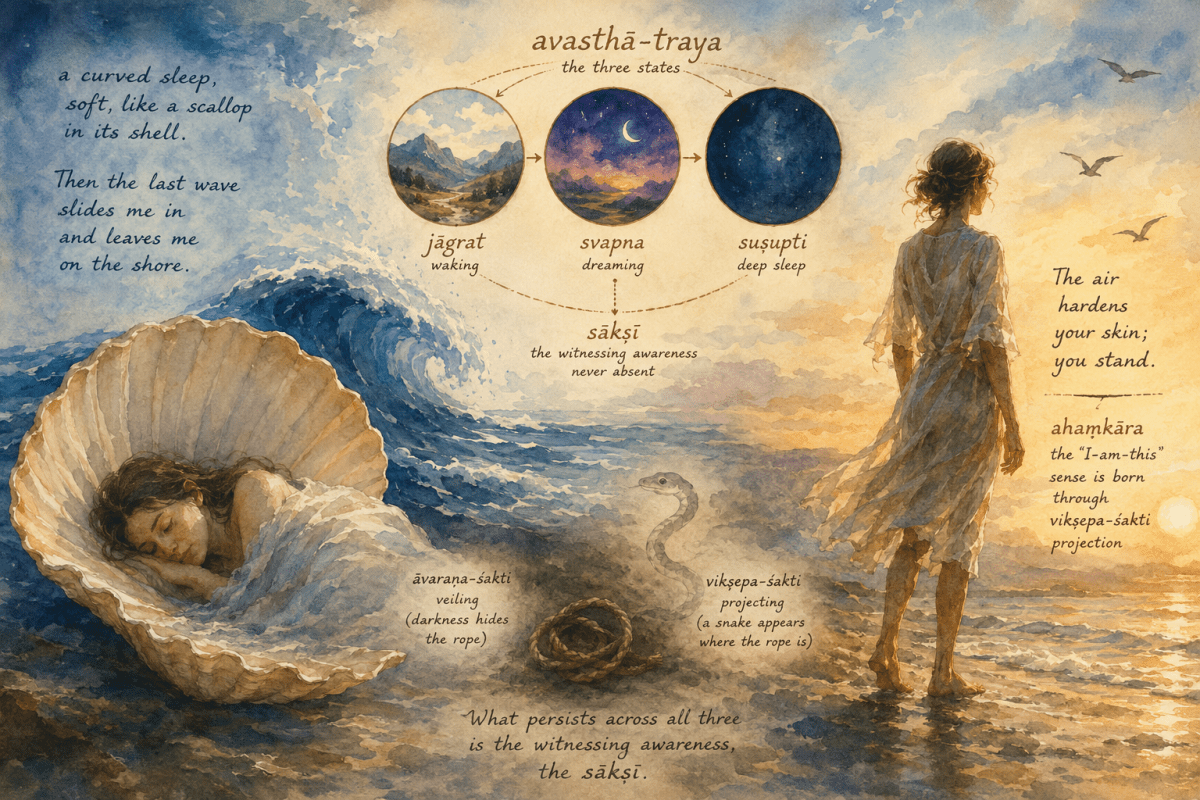
These are morning matters, pictures you dream as the final wave heaves you up on the sand to the bright light and drying air. You remember pressure, and a curved sleep you rested against, soft, like a scallop in its shell. But the air hardens your skin; you stand; you leave the lighted shore to explore some dim headland, and soon you’re lost in the leafy interior, intent, remembering nothing.

~ Anne Dillard, Pilgrim at Tinker Creek
Two Cartographers of the Same Country
There is a particular pleasure — half intellectual, half devotional — in discovering that two people who never read each other, working in entirely different idioms, have mapped the same terrain. Annie Dillard, an American nature writer whose Pilgrim at Tinker Creek won the Pulitzer Prize, wrote a single paragraph about waking from sleep. She was not doing metaphysics. She was doing what she always does: watching closely and rendering what she saw in exact, sensuous prose. And yet the paragraph reproduces, almost stroke for stroke, the architecture that the Māṇḍūkya Upaniṣad and centuries of Advaitic commentary built around avasthā-traya, the doctrine of the three states of consciousness.
This convergence is worth taking seriously precisely because it is unintended. Dillard was not translating Śaṅkara into Virginia hill-country English. She was reporting, with a naturalist’s fidelity, what it actually feels like to surface from sleep. When a description arrived at independently through direct phenomenological attention matches a metaphysical map drawn two and a half thousand years earlier on the other side of the planet, one of two things is happening: either the map is tracking something structurally real about consciousness itself, prior to culture and language — or we are pattern-matching two unrelated things because we already wanted to find the pattern. Both possibilities deserve a hearing. This essay works through the correspondence in detail, and then, in the interest of intellectual honesty, turns to consider where the parallel might mislead.
The Upanishadic Map, Briefly
Advaita’s account of the three states rests on a simple but radical observation: waking (jāgrat), dreaming (svapna), and dreamless sleep (suṣupti) are not three activities of one fixed self but three worlds, each with its own body, its own object-field, and its own sense of “I.” What persists across all three — the thread on which these three beads are strung — is not the ego of any one state but the witnessing awareness, the sākṣī, which is never absent, never asleep, never born and never dies with any particular state.
Two technical terms matter for reading Dillard: āvaraṇa-śakti, the veiling power, which hides the substrate (as darkness hides a rope, so that you cannot see it is a rope), and vikṣepa-śakti, the projecting power, which then throws an appearance over the concealment (you now see a snake where the rope was). Deep sleep, in this scheme, is the one state that suffers only from veiling and not from projection — nothing is being falsely superimposed there, because there is no object-field at all. It is not an absence of consciousness; it is consciousness without the added labor of appearing as a world. That single distinction — deep sleep as innocent concealment rather than as blank nonexistence — is the hinge on which the entire Dillard reading turns.
Reading the Paragraph, Phrase by Phrase
The ocean and the scallop. Dillard’s sleeper rests “against” something — “a curved sleep… soft, like a scallop in its shell.” A shell is not a prison; it is a perfectly fitted home, inseparable from the creature that grew it. This is a remarkably precise image for suṣupti as Advaita actually describes it: not oblivion, but ānanda — an unmediated peace that arises simply because the subject-object split has temporarily folded back into its causal seed-state (kāraṇa śarīra). Most people who report their own deep sleep describe it as a gap, a nothing. Advaita’s counterintuitive claim — and Dillard’s image quietly agrees — is that what actually gets lost there is not consciousness but reflected consciousness, the mind’s borrowed shine. The felt “blankness” is itself evidence of how thoroughly the mind, once it returns, misreads its own absence as the absence of awareness rather than the absence of an object to be aware of.
The final wave. Something moves the sleeper from shell to shore. In Vedāntic terms this is prārabdha karma — that portion of accumulated tendency whose fruit is already “in motion” and must be lived out — stirring the causal state back toward the subtle, dream-adjacent state (taijasa) and finally into the gross waking world (viśva). In more contemporary, psychological language, this is the moment developmental psychology describes when an infant’s primary, boundary-less experience (what Winnicott called a state of unintegration, prior to any felt separation between self and environment) begins to organize into a bounded ego. No trauma theory is needed to explain this transition each morning — it is simply the mind’s habitual momentum reasserting itself, the way a river resumes its course the instant an obstruction is removed.
Hardening skin, standing body. “The air hardens your skin; you stand.” This is ahaṃkāra being born in real time — Advaita’s term for the “I-am-this-body-mind” sense that vikṣepa-śakti throws over pure witnessing. What was, a sentence earlier, unlocalized awareness resting in its own fullness becomes, in the space of a clause, a located creature subject to weather, gravity, and skin. Dillard’s verb choice is exact: it is the air that hardens the skin, not the sleeper who chooses to harden it. Individuation, whether described by Vedānta or by object-relations theory, is not usually experienced as a decision. It happens to you, the way weather happens to a coastline.
The lighted shore, the dim interior. Here Dillard performs her most striking inversion, and Advaita performs an almost identical one. Ordinarily light is truth and darkness is ignorance. Dillard reverses this: the shore, where dream-memory is still available, is bright; the forest of ordinary waking engagement is “dim.” Advaita’s parallel move is to treat the waking state — for all its practical brightness — as a condition of avidyā, because the light it operates by is Brahman’s own luminosity (prakāśa) already fragmented and refracted through mind and sense-organ, the way sunlight refracted through a prism produces colour but loses the sun’s original wholeness. Neither Dillard nor Advaita is being merely clever here. Both are pointing at something a good phenomenologist would recognize: heightened engagement with an object-field is not the same event as heightened awareness — you can be maximally alert to your inbox and minimally aware of anything else, including yourself.
The leafy interior. “Lost in the leafy interior, intent, remembering nothing” is a near-technical description of what Advaita calls absorption in nāma-rūpa, names and forms — the vyāvahārika, transactional level of reality, where the jīva becomes so identified with its projections that the witness recedes from view without ever actually leaving. Contemporary neuroscience offers a loose but genuinely useful secular analogue here: the brain’s default-mode network, associated with self-referential rest and mind-wandering, characteristically quiets down when attention narrows onto an external, effortful task. This is not proof of anything metaphysical — it is simply a description, at a different level of resolution, of the same narrowing Dillard is describing at the level of felt experience: focus purchases itself at the price of self-remembering.
The pronoun “you.” Dillard never writes “I remembered.” She writes “you remember,” “you stand,” “you leave,” turning a private recollection into something universally addressed. Advaita would say this is not a literary trick but an accidental unveiling of the truth: the one who watches the wave, notices the hardening skin, and later registers “remembering nothing” cannot itself be the changing mind, because the mind is precisely what is being watched changing at every clause. That constant witness is the sākṣī — and Dillard’s grammar, whether she intended it or not, puts the reader in exactly that seat.
At another level, the paragraph quietly invokes the story of evolution. Life first emerged from the sea before colonizing the land, and Dillard subtly reenacts that ancient biological history within the experience of awakening. The sleeper is washed ashore from the ocean, acclimates to dry air, and eventually enters the forested interior of the land. This evolutionary echo is characteristic of Pilgrim at Tinker Creek, where individual human experiences repeatedly mirror vast natural and geological processes. A single morning awakening becomes, almost imperceptibly, a recapitulation of millions of years of life’s migration from water to earth. Such layering of scales—from the intimate to the evolutionary—is one of Dillard’s signature techniques throughout the book.
The Gita’s Confirming Verse
The Bhagavad Gītā offers its own confirming verse. In 2.69, Krishna says that what is night for all beings is the time of wakefulness for the self-mastered, and what all beings call waking is night for the sage who truly sees. Śaṅkara’s own commentary on this verse sharpens the point: he glosses “night” not as literal darkness but as tamas — that which obliterates distinctions — arguing that ordinary sense-engagement is itself a kind of sleep from which the realized yogī has “arisen,” while what the world calls waking remains, to the sage, indistinguishable from a night in which the sleepers dream they are awake, since ordinary awareness of sense-objects is, to the self-realized sage, like things enshrouded by darkness, and the self-restrained one is described as having arisen from the sleep of ignorance. It is a striking thing to find a nature writer from the Blue Ridge Mountains arriving, through nothing but careful attention to her own waking, at the same paradox a South Indian commentator drew out of a Sanskrit battlefield dialogue a millennium and a half earlier.
Where the Parallel Might Mislead
One caution is due here, and it matters enough to state plainly. Dillard was not being Vedāntic — she was being explicitly, self-consciously Christian. She has said directly that art was her interest but mysticism her message, and specifically Christian mysticism, going so far as to call Pilgrim at Tinker Creek fundamentally a work of theology rather than nature writing. Scholars have further noted that the book’s very structure follows the medieval contemplative’s two-stage path: the first half tracing the journey to God through action, will, and materials (via positiva), and the second turning toward the darker apophatic path, the soul’s negation of created things in pursuit of the uncreated. This is not the Advaitic path of jñāna dissolving avidyā through discrimination between the Self and the not-Self; it is the Dionysian via negativa of a soul in relationship with a Creator who remains other even in union. Reading her paragraph as smuggled Vedānta risks doing to Dillard what comparative religionists have long warned against doing to any text: treating superficial resemblance as if it demonstrated a real underlying identity. The historian of religion Jonathan Z. Smith made this his life’s methodological argument — that comparison is an act of imaginative construction performed by the comparer, not a passive discovery of hidden kinship between traditions, and that resemblance alone, without an argued causal or structural connection, remains an analogy rather than an identity. What we may be witnessing in Dillard is not proof that Advaita is universally true but evidence that any sufficiently honest phenomenology of waking will bump into certain structural facts—narrowing of attention, loss of a prior state’s memory, and the felt birth of a bounded self—because these are simply true of how human consciousness transitions between states, independent of which metaphysics one later hangs on the observation.
Holding this caution alongside the correspondence itself does not weaken the essay’s central observation. It disciplines it. The value of the parallel is not that it proves Advaita correct by literary corroboration; it is that Dillard, working from a wholly different tradition and toward a wholly different theological end, arrived independently at a description of waking that a sensitive Advaitin will find eerily familiar—and that convergence, modestly stated, is itself worth noticing, whether one finally explains it through prārabdha karma or through Christian apophaticism.
The Wisdom Folded Into Prose
Perhaps the deeper lesson here is what great literature is quietly capable of holding without ever announcing it. A writer attending closely enough to one ordinary experience—waking, in this case—can lay down an image so exact that it ends up containing more than she consciously intended, more, perhaps, than she could have stated outright in her own expository voice. Dillard was not encoding doctrine. She was simply looking hard at something true, sentence by sentence, and it is precisely that fidelity to the looking which allows an older, wholly separate tradition to find itself already resident in her prose. This is one mark of literature at its best: it rarely says only one thing well. It holds several true things folded together, patiently, waiting for whichever reader arrives with the eyes to find them — this year the birth symbolism, next year the evolutionary echo, some later year, perhaps, the architecture of the three states.
The right response to a paragraph like this is probably not exercise but stillness. To read “you remember pressure, and a curved sleep you rested against, soft, like a scallop in its shell” is already to be handed something to sit with, not a claim to evaluate but an image to let settle — the way a single verse of scripture, or a well-placed koan, is meant to be carried rather than solved. Nothing needs to be scheduled or verified for this to work. It is enough to read the paragraph slowly, more than once, in silence, and to let it stir whatever it stirs — a faint recollection of one’s own last waking, perhaps, or the quiet intimation that the “you” being addressed is not entirely a stranger. That noticing need not be chased down or turned into a discipline. It can simply be allowed to arise, the way recognition sometimes arrives in meditation: not fetched by effort, but received, unbidden, in a moment of unguarded attention to an ordinary sentence.
Held this way, the whole essay becomes less an argument than a demonstration. Advaita’s architecture is not being imposed on Dillard’s paragraph from outside; it is being found, already present within it — the way a listener who already knows a piece of music will hear an old theme quietly return inside an unfamiliar arrangement, without the composer having placed it there on purpose. The layering itself — waking as birth, birth as evolution, evolution as the soul’s small daily odyssey, the odyssey witnessed by something that never itself changes — is not a stack of separate claims. It is what happens when language becomes precise enough that one true observation about experience opens, without strain, into the next. That, in the end, may be the most Advaitic thing about the paragraph: not any single image within it, but the way its truth continues to deepen the longer one is willing to sit quietly in front of it, asking nothing of it at all.
A Remarkable Convergence, Modestly Held
Set side by side, Dillard’s paragraph and Advaita’s map of the three states are difficult to read as coincidence, even though they demonstrably are one: the scallop-shell sleep as suṣupti‘s innocent, object-less peace; the final wave as prārabdha karma stirring the causal state into motion; the hardening skin as the birth of ahaṃkāra through vikṣepa-śakti; the “dim” waking forest as Advaita’s own inversion of light and ignorance; and the address to “you” as an unwitting invocation of the sākṣī, the witness that alone remains constant across all three states — a structure the Bhagavad Gītā and Śaṅkara’s own commentary state directly in the paradox that the sage’s night is the world’s day. That a Pulitzer-winning American nature writer, working entirely outside the Vedāntic tradition and with no apparent knowledge of it, should render the architecture of avasthā-traya this precisely, phrase by phrase, is genuinely remarkable — worth dwelling on rather than explaining away. At minimum, it suggests that the three-state structure is tracking something real about how waking actually feels, available to sufficiently patient attention regardless of the metaphysics one starts from.
That said, the convergence is best held loosely rather than triumphantly. Dillard’s own stated framework was Christian and apophatic, built on the soul’s approach to a Creator who remains other even in the deepest union — not on the Advaitic dissolution of a self that was never, finally, separate from Brahman to begin with. The resemblance, in other words, is a convergence of phenomenology — of what waking feels like from the inside — and not evidence of a shared theology. Dillard would very likely not recognize herself in an Advaitic reading of her own paragraph, and that reservation should not be smoothed over for the sake of a tidier essay. The paragraph’s real teaching value lies exactly at this seam: two traditions that disagree about almost everything metaphysically important — the nature of the self, the status of the world, what waking ultimately leads toward — nonetheless arrive, when they look closely enough at an ordinary morning, at strikingly similar reports of what actually happens in the seconds before the forest closes in. It is that arrival, independent and unclaimed by either side, that makes the paragraph worth reading twice.
Creating deep and quality content takes time and resources. By donating, you directly fund the research and effort that goes into every single post. If my work has helped you or inspired you, please consider supporting my work. Even a $3 donation makes a huge difference.


