
Opening Passages of Nobel Prize-Winning Author Le Clézio’s Novel—Desert
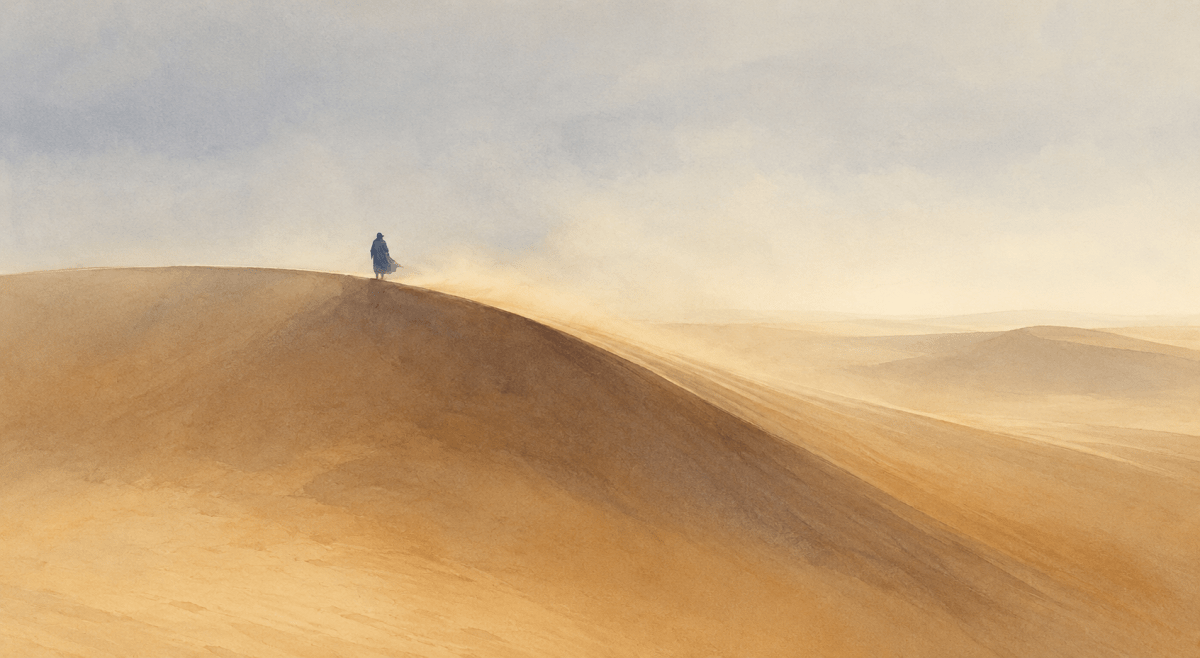
THEY APPEARED as if in a dream at the top of the dune, half-hidden in the cloud of sand rising from their steps. Slowly, they made their way down into the valley, following the almost invisible trail. At the head of the caravan were the men, wrapped in their woolen cloaks, their faces masked by the blue veil. Two or three dromedaries walked with them, followed by the goats and sheep that the young boys prodded onward. The women brought up the rear. They were bulky shapes, lumbering under heavy cloaks, and the skin of their arms and foreheads looked even darker in the indigo cloth.
They walked noiselessly in the sand, slowly, not watching where they were going. The wind blew relentlessly, the desert wind, hot in the daytime, cold at night. The sand swirled about them, between the legs of the camels, lashing the faces of the women, who pulled the blue veils down over their eyes. The young children ran about, the babies cried, rolled up in the blue cloth on their mothers’ backs. The camels growled, sneezed. No one knew where the caravan was going.
The sun was still high in the stark sky, sounds and smells were swept away on the wind. Sweat trickled slowly down the faces of the travelers; the dark skin on their cheeks, on their arms and legs was tinted with indigo. The blue tattoos on the women’s foreheads looked like shiny little beetles. Their black eyes, like drops of molten metal, hardly seeing the immense stretch of sand, searched for signs of the trail in the rolling dunes.
There was nothing else on earth, nothing, no one. They were born of the desert, they could follow no other path. They said nothing. Wanted nothing. The wind swept over them, through them, as if there were no one on the dunes. They had been walking since the very crack of dawn without stopping, thirst and weariness hung over them like a lead weight. Their cracked lips and tongues were hard and leathery. Hunger gnawed their insides. They couldn’t have spoken. They had been as mute as the desert for so long, filled with the light of the sun burning down in the middle of the empty sky, and frozen with the night and its still stars.
They continued to make their slow way down the slope toward the valley bottom, zigzagging when loose sand shifted out from under their feet. The men chose where their feet would come down without looking. It was as if they were walking along invisible trails leading them out to the other end of solitude, to the night. Only one of them carried a gun, a flintlock rifle with a long barrel of blackened copper. He carried it on his chest, both arms folded tightly over it, the barrel pointing upward like a flagpole. His brothers walked alongside him, wrapped in their cloaks, bending slightly forward under the weight of their burdens. Beneath their cloaks, the blue clothing was in tatters, torn by thorns, worn by the sand. Behind the weary herd, Nour, the son of the man with the rifle, walked in front of his mother and sisters. His face was dark, sun-scorched, but his eyes shone and the light of his gaze was almost supernatural.
They were the men and the women of the sand, of the wind, of the light, of the night. They had appeared as if in a dream at the top of a dune, as if they were born of the cloudless sky and carried the harshness of space in their limbs. They bore with them hunger, the thirst of bleeding lips, the flintlike silence of the glinting sun, the cold nights, the glow of the Milky Way, the moon; accompanying them were their huge shadows at sunset, the waves of virgin sand over which their splayed feet trod, the inaccessible horizon. More than anything, they bore the light of their gaze shining so brightly in the whites of their eyes.
Introduction
Before anything else, a confession about method.
What follows is not a claim about what J.M.G. Le Clézio believed, intended, or had read. There’s no reason to think he was reaching for Advaita Vedanta—the non-dual strand of Indian philosophy that insists, at bottom, there is only one undivided reality, and that the sense of being a separate self looking out at a separate world is a kind of optical error—when he wrote the opening pages of Desert. He was almost certainly drawing on something closer to phenomenology, on his own long relationship with the Sahara, on a Franco-Mauritian sensibility steeped in ideas of exile and indigeneity that owe nothing to Shankara.
But a text doesn’t have to know what it’s doing for a reader to find it doing that anyway. Readers have found Blake in Kabbalah he never studied and Melville in a Buddhism he barely encountered, not because those writers were secretly initiates, but because certain human experiences—vastness, self-loss, the wearing away of the ordinary boundary between “me” and “everything else”—keep getting described in strikingly similar terms by people who never met. What follows is that kind of reading: not an excavation of Le Clézio’s intentions, but an overlay, a second language laid across the first to see what lights up. The earlier essay on this passage already noticed the ground trembling—the desert seeming to dissolve the line between the one who perceives and the thing perceived. Advaita simply has an old and very precise vocabulary for exactly that trembling, and it would be a shame not to borrow it.
The wind that erases a line
Advaita’s central teaching is disarmingly simple to state and famously hard to live: tat tvam asi, thou art that. Not thou shalt become that, not thou art connected to that—thou already, right now, art that, and the sense of being a separate someone standing apart from the whole is the one mistake underneath all the others. The tradition calls this mistake avidya, usually translated as ignorance, though it isn’t a lack of information so much as a persistent misreading—the way a coiled rope glimpsed at dusk is misread as a snake. Nothing about the rope changes when you see it correctly. Only the seeing changes.
Read Le Clézio’s caravan through that vocabulary and the sentence that anchors the whole passage stops being merely poetic. “The wind swept over them, through them, as if there were no one on the dunes.” In Advaitic terms, this isn’t a metaphor for how thoroughly exhausted people can feel. It’s closer to a literal description of what happens when the rope stops being mistaken for a snake—when the boundary that usually organizes experience into “self” and “wind” simply isn’t being enforced anymore, even for a moment, even by accident. Wind doesn’t ordinarily pass through a person; it passes around one, because a person is, among other things, a boundary-maintaining project. The instant that project relaxes, wind stops meeting resistance. It just moves through the way it moves through empty air, because in this reading there was never really a wall there to begin with—only the habit of imagining one.
No other path: the vanishing doer
Advaita has a particular quarrel with the idea of the doer—the sense that “I” am the one choosing, acting, and deciding where my feet go next. The tradition doesn’t deny that feet move. It denies that there’s a separate little self inside the body pulling the strings, as opposed to the whole of existence simply unfolding, action arising out of conditions the way weather arises out of pressure systems, with no free-floating homunculus required to explain any of it.
“They were born of the desert,” Le Clézio writes, “they could follow no other path.” Notice what’s missing from that sentence: choice. Not chose no other path, but could follow none. The men select their footing “without looking,” and the whole caravan moves along tracks so old they function almost like a memory the ground itself is holding, rather than a plan any individual devised. Read plainly, this is nomadic expertise—people who know their terrain so well that navigation has become unconscious. Read through Advaita, it’s something closer to the tradition’s account of a life lived without a doer standing behind it: motion continuing to happen, entirely competently, with the fiction of a controller quietly not showing up for work.
This is echoed, more starkly, a few lines later: “They said nothing. Wanted nothing.” Desire, in Advaita, is one of the doer-fiction’s main tools—the mechanism by which a separate self keeps proving its own existence to itself, moment after moment, by wanting this and not that. A creature that has stopped wanting has, in this reading, stopped needing to perform separateness. It isn’t emptied out. It’s finally quiet enough to notice it was never as separate as the wanting had implied.
The eye behind the eye
There’s an old teaching, from the Kena Upanishad, that asks what could possibly see the eye itself, hear the ear itself, think the mind itself—and answers that whatever that is, prior to and behind every particular act of perceiving, is what the tradition ultimately means by the innermost Self. Not a bigger, better eye. Something the eye borrows its seeing from.
Le Clézio’s passage keeps circling something uncannily similar. The women’s eyes are “like drops of molten metal,” barely registering the vastness they scan for a trail—as if what’s doing the seeing here isn’t quite personal vision, something closer to metal catching and holding light than to an individual consciously looking. And then Nour, the one figure who steps out of the collective “they” into something like individuality, is marked by nothing except his gaze: eyes carrying a light the text calls “almost supernatural.” By the passage’s final movement, this has become true of everyone—more than hunger, more than thirst, more than the cold nights, “they bore the light of their gaze shining so brightly in the whites of their eyes.”
In an Advaitic register, that’s close to a working definition of the Self: not a thing you see with, but the light by which seeing happens at all—borrowed by every eye, belonging to none of them, no more the property of Nour’s particular face than the sun is the property of whichever dune happens to be lit by it at noon. The gaze doesn’t originate in the person. The person is, briefly, where the gaze becomes visible.
Waves that were never separate from the sea
Advaita’s favorite image for the relationship between the individual and the whole is the wave and the ocean. A wave is real enough—you can point to it, name it, and watch it break—but it was never, for one instant, a thing apart from the water it’s made of. There is no boundary you could draw between “wave” and “ocean” that the ocean itself would recognize. The boundary is useful for talking about waves. It is not there in the water.
It is hard, having read that image once, to encounter Le Clézio’s dunes described as “rolling,” the sand becoming “waves of virgin sand” beneath the travelers’ feet, and not feel the metaphor lean in the same direction. An ocean offers no shore to stand on and watch from; you’re in it, or you aren’t in the scene at all. By giving the desert this oceanic grammar, the passage quietly removes the option of observing from dry land. There is no place outside the wave-and-water system from which someone could watch the caravan as a separate thing moving across a separate surface. Advaita would say, “Correct—there never is, anywhere, for anyone.” That’s the whole diagnosis. We only ever imagined the dry land.
The witness who was never outside
Which brings the reading to its real center of gravity and to the sentence Advaita would probably flag as the passage’s most important without any embellishment at all: “There was nothing else on earth, nothing, no one.” Taken to its Advaitic conclusion, this isn’t hyperbole about how empty a desert looks. It’s closer to neti neti, the tradition’s method of getting at ultimate reality by negation—not this, not that—stripping away every particular thing one could point to, every “someone” and “something,” until what’s left isn’t emptiness but the undivided field in which “someone” and “something” were always temporary distinctions, useful the way ripples are useful, real the way ripples are real, but never, underneath, actually two.
That’s also, finally, what makes the title of this essay’s companion piece, When There Is No One on the Dunes — sit so naturally beside this older vocabulary. Advaita doesn’t claim people disappear either. It claims the separate observer — the little self imagined to be standing behind the eyes, distinct from the wind, distinct from the sand, distinct from whatever it’s currently looking at — was never quite as solid as grammar makes it sound. “I see the desert” smuggles in two things and a gap between them. Advaita, and this passage, keep proposing that the gap was the only fictional part.
The one thing held close
It would be too tidy to end there, though, because the passage contains a detail that pushes back against its own dissolving logic, and Advaita has a place for that pushback too. Amid all this porousness—wind passing through bodies, silence borrowed from the desert, eyes carrying a light that isn’t personally owned—one object in the scene is held with the opposite of porousness. The man carrying the rifle keeps it against his chest, “both arms folded tightly over it,” the barrel raised like a flagpole. Of everything in the caravan, this alone is gripped, defended, and kept separate from the wind moving through everything else.
Advaita has a word for exactly this kind of holdout: ahamkara, the ego-function, the last knot in an otherwise dissolving rope. The tradition doesn’t pretend this knot vanishes just because the deeper teaching is true. Even texts describing the most complete recognition of non-duality still describe a body that eats, sleeps, and—when necessary—defends itself; the doctrine was never that the body-mind stops behaving like a separate thing, only that something behind it stops mistaking itself for one. The rifle, then, doesn’t undercut the reading so much as complete it. It’s the one place in the passage where separateness is still doing necessary work—protecting a family crossing a hostile emptiness—even while everything around it, sand, silence, gaze, and light, has already let that separateness go quiet. Non-duality, in this frame, was never a claim that the desert stops being dangerous. It’s a claim about what’s actually being defended and by whom, once the question is asked closely enough.
A caveat, restated
None of this makes Le Clézio a secret Vedantin, and it shouldn’t be read that way. He gives the caravan real thirst, real cracked lips, and real fear of a shadeless valley ahead—nothing in this reading is asking those to be metaphors for enlightenment, and Advaita itself has never claimed that non-duality erases hunger or makes hardship comfortable. What this reading suggests instead is something quieter: that when a writer pays close enough attention to bodies moving through overwhelming space and stays honest about what actually happens to perception, will, and boundary under that kind of pressure, the resulting language starts to rhyme—unplanned, maybe unavoidably—with a much older description of what’s left when the fiction of separateness gets tired and sets itself down for a while.
The caravan keeps walking toward a valley with no water in it, entirely real. And somewhere behind the reading, quietly, is the suggestion that the valley, the wind, the walkers, and the one now finishing this sentence were never, in the way that matters most, four different things to begin with.


