
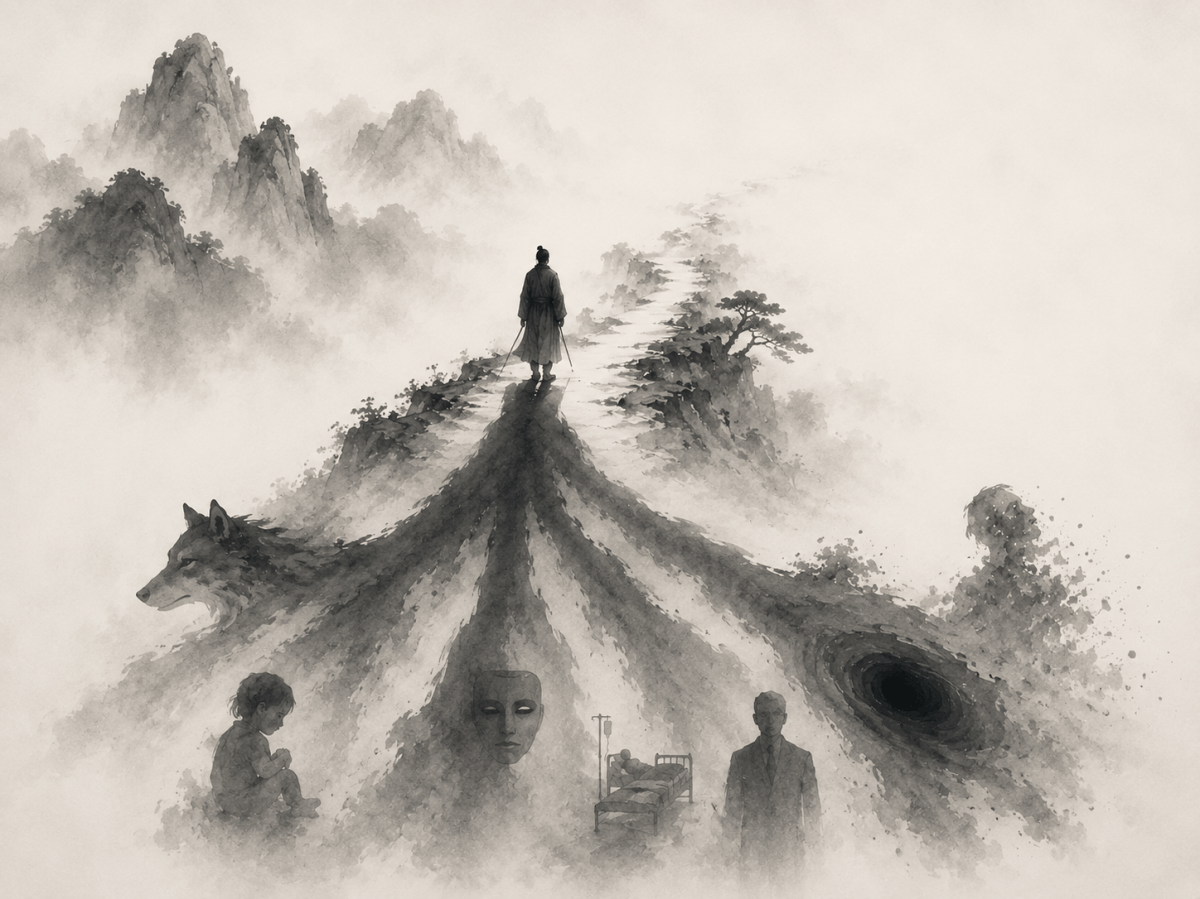
The Invisible Wall — The Resistance No One Explains
Mysteriously, over the years, I found myself hitting the same invisible wall over and over again. As a spiritual teacher, I began noticing the same pattern in student after student until I could no longer dismiss it as coincidence.
A student arrives sincere, sometimes desperate, ready to ask the oldest question there is: “Who am I?” with what looks like total commitment. Most of them have read the books, watched videos, and even attended retreats. They are tired of second-hand answers. They no longer want another philosophy; they want to know who they really are.
After years of teaching—and receiving more than a few unexpected shocks—I developed a mental checklist of questions to run through with every new student so they understand what self-inquiry is and, just as importantly, what it isn’t. In our first meeting, almost everyone sails through these questions.
And then something curious happens. Nine out of ten never even open their accounts! The first meeting proves to be the last. And for the lone one who miraculously does manage to open an account, the roller coaster has just begun.
Weeks or months in, the inquiry quietly stops. Rarely because it has been disproved or argued away, but because something like a fog begins to settle in. There is sudden busyness, a new intellectual or spiritual detour, irritation with the teacher who suddenly seems less insightful, or, occasionally, the comforting conviction that one has already arrived.
From the outside, it looks as though interest has simply waned, but from the inside, something far more complex is happening. The student unconsciously has come under the grip of fear, though it rarely announces itself as fear. Instead, it borrows the language of reason.
- “I’m getting nowhere.”
- “This practice isn’t for me.”
- “I don’t have time.”
- “Maybe I should try another tradition.”
- “I’m already enlightened.”
- Or, at the other extreme, “I’m becoming emotionally unstable.”
These explanations feel perfectly convincing because their mind attempts to make sense of a resistance whose true source remains hidden. But the student is mistaking the visible symptoms for the cause itself.
Unbeknownst to them, there is a hidden architecture beneath these fears. Nondual traditions identify this as the ego resisting. But the literature rarely explores the architecture of that resistance. What exactly is it that provokes such extraordinary resistance to a seemingly innocuous question—”Who am I? It is almost as though the mind possesses a psychological immune system that rejects self-inquiry the way the body rejects a transplanted organ even when the operation was necessary. As a result, one sees intelligent, emotionally mature people—people who genuinely long for freedom—often retreat from self-inquiry precisely when it begins to deepen.
This puzzling phenomenon can be only understood through the combined lenses of nondual teachings (Advaita Vedānta), developmental psychology, psychoanalysis, neuroscience, and sociology. The resistance to self-inquiry turns out not to be one fear but several, operating simultaneously at different layers of human experience. Unless these layers are distinguished, teachers often prescribe the wrong medicine, practitioners misunderstand their own hesitation, and profound opportunities for genuine transformation are quietly lost.
The fear beneath self-inquiry is not a single wall.
It is an entire architecture.
The First Fear: The Fear of Ceasing to Exist
This is the fear that nondual traditions are quite vocal about in their literature. These verses from Cahapter 9 of the Taittirīya Upaniṣad bear it out with a powerful metaphor.
5. When indeed this (soul) makes in this One even the smallest break, then for him there is fear.
6. That, verily, is fear to the knower who does not reflect.
7. From fear of Him does Wind blow, from fear of Him does Sun rise, from fear of Him Agni and Indra (act) and Death the fifth does run.
At the traditional level, these verses describe the entire cosmos functioning under the sovereignty of the one consciousness. Even the great cosmic powers—the wind, the sun, fire, Indra, and death—perform their appointed functions out of awe before the Supreme. Śaṅkara compares them to ministers faithfully carrying out the commands of a king.
Read psychologically, however, the metaphor becomes even more striking. If even the cosmic powers are portrayed as acting under the irresistible authority of the one consciousness, what hope does the ordinary human ego have of maintaining its imagined independence? The separate self is not merely something that occasionally experiences fear. It is a structure organized around the impossible project of preserving its separateness before the very Reality from which it has never been separate.
Picture a whirlpool in a river. It has a shape, a location, and even a kind of behavior—it can be pointed at, named, and described as more or less energetic. But it has no substance apart from the water passing through it. If a whirlpool could ask, “What am I, really?” and inquire honestly, the water would remain entirely undisturbed, but the whirlpool, as a separate thing, would not survive the answer. This is why the fear feels like death to the one experiencing it: in a sense, for the whirlpool, it is. In fact, it was never a separate entity to begin with. Only a pattern briefly mistaking itself for a thing.
This is the first layer of the hidden architecture behind the invisible wall encountered by so many seekers. Self-inquiry is not asking an innocent philosophical question after all. The mind’s psychological immune system mistakes the questioning of its own separate existence for a threat to survival itself and instinctively mobilizes its defenses.
The Second Fear: The Fear of a House Not Yet Built
This is where modern depth psychology offers an important corrective to Advaita. While Advaita steadfastly urges us to see through the ego as an obscuration, depth psychology reminds us that the ego is also a genuine developmental achievement.
A child is not born with a stable sense of self. Identity emerges gradually through thousands of interactions with parents, siblings, friends, and the surrounding world. Healthy boundaries are painstakingly constructed over years. Emotional regulation develops slowly. The capacity to tolerate uncertainty, intimacy, frustration, and loss is learned through relationship rather than given at birth. Before these structures mature, they perform indispensable psychological functions, enabling us to navigate the world and remain integrated under stress.
Jack Engler, both a clinical psychologist and long-time Buddhist practitioner, expressed this insight in a sentence that has become famous:
“You have to be somebody before you can be nobody.”
Engler had watched, in his own clinical practice, meditators whose spiritual ambition outran their psychological development—people for whom the promise of no-self became an unconscious shortcut around the slower work of becoming an integrated self in the first place. For them, inquiry didn’t liberate; it destabilized, because the psychological structure required to survive its own transcendence had not yet fully formed.
Imagine a temple still under construction. Scaffolding surrounds the unfinished structure. It obscures the beauty of the building, yet without it the temple could never be completed. Eventually the scaffolding must come down. But no sensible architect removes it while the arches are still unable to support themselves.
The problem is removing it too early. The real question is never “Is this ego resistance?”—the answer is almost always yes—but “Is the structure finished enough to stand without it?”
The first fear belonged to ontology. This one belongs to development. Confusing the two has produced no small amount of suffering in contemporary spirituality. Over the years, I have seen some students develop dissociative tendencies so pronounced that they required professional psychiatric care. Though the separate self is ultimately an illusion, from the standpoint of development it may still be performing work that has not yet been completed. A wise teacher respects that.
The Third Fear: When the Body Panics Before the Mind Understands
Cowards die many times before their deaths;
The valiant never taste of death but once.
— William Shakespeare, Julius Caesar
Psychological fear is not experienced merely as an idea. The nervous system often reacts to perceived threats to identity with many of the same physiological responses that accompany threats to bodily survival. This may have much to do with how we have evolved as humans.
Modern neuroscience has identified an important neural correlate of our ordinary sense of self: the Default Mode Network (DMN). It is a set of interconnected brain regions centered on the medial prefrontal and posterior cingulate cortices, active during self-referential thought, autobiographical memory, and mind-wandering.
Further, researchers such as Anil Seth and Karl Friston describe the brain not as a passive recorder of reality but as a continuous prediction engine, generating a model of the world and of itself in order to anticipate what comes next. Within this predictive-processing framework, the brain constructs a model of a coherent, continuous self. The Default Mode Network (DMN) plays a central role in maintaining this self-model, which serves as a stable reference point that makes prediction and action dramatically more efficient.
And it is precisely for this reason that the brain does not experience any loosening of its self-model as insight. Initially, it experiences it as a threat. The entire predictive architecture assumes that a continuous, bounded self exists and must be protected. This is not mere superstition but evolutionary good sense, since for nearly the whole of human history, severe disruptions to this sense of self often accompanied situations of genuine danger: disorientation before predators, exile from the group, and the confusion of fever or delirium. A nervous system that treats the dissolving of its own self-model as an emergency is not malfunctioning. It is doing precisely what it evolved to do.
Imagine an aircraft flying on autopilot for several hours. Suddenly the pilot disengages the automated controls. The aircraft immediately sounds alarms. Nothing is necessarily wrong. The alarms are doing exactly what they were designed to do. Likewise, when inquiry begins dismantling one of the brain’s oldest organizing assumptions, the nervous system does not calmly conclude, “Ah, liberation.”
It sounds every alarm it possesses.
Seen in this light, fear is no longer evidence that inquiry has failed. In fact, in this case, fear is evidence that the inquiry has reached a layer far deeper than ordinary thought.
One is never afraid of the unknown; one is afraid of the known coming to an end.
~ J. Krishnamurti
The Fourth Fear: Becoming Someone the World No Longer Recognises
So far, we have looked at the self ontologically, developmentally, and neurologically. There is one more dimension that spiritual traditions often underemphasize: the social self.
Long before psychology became a formal discipline, the sociologist George Herbert Mead observed that the self is fundamentally relational. We do not possess an identity solely for our own benefit. We also possess one for everyone else. We become who we believe ourselves to be through countless interactions with other people. Parents call us by a name. Teachers assign us roles. Friends remember our history. Society gradually hands us a biography. Identity is, in this sense, a kind of social currency.
Imagine introducing yourself without any stable identity whatsoever. No name, no occupation, and no personal history. The social world functions because people remain recognizable to one another. Relationships depend upon predictability, families depend upon relatively stable roles, and children need dependable parents. Employers expect consistency. Communities rely upon identities that endure long enough to sustain cooperation.
Considering these facts, self-inquiry threatens more than an inner sense of “I.” It threatens the entire framework of social relationships that inner sense supports. People sense, often correctly, that visible destabilization of one’s self-narrative carries real costs—to relationships, credibility, belonging, and, often, livelihood. This is not vanity; it is frequently an accurate read of social reality. A teacher who brushes these concerns aside as ‘mere māyā’ may be speaking from the standpoint of ultimate reality while overlooking the demands of transactional reality.
None of this makes the social self ultimately real. It simply makes it socially indispensable. Realizing that a passport is a legal fiction does not eliminate the need to carry one when crossing a border. Likewise, seeing through the personal identity does not abolish its practical usefulness. It changes one’s relationship to it.
Learning to Read Fear
Seen in this light, fear ceases to be an obstacle and becomes information. Not all fears are speaking about the same thing. The task is no longer to overcome fear but to discover which fear is speaking. One belongs to ontology. Another to development. Another to the nervous system. Another to society.
The skill lies in recognizing which voice is speaking. A person suffering genuine derealization does not need another lecture on non-duality. They need grounding, perhaps rest, or perhaps professional support. The nervous system must first recover its capacity to feel safe. Someone whose ego is still performing essential developmental work may benefit more from psychotherapy than prolonged inquiry. Someone whose fear concerns relationships deserves honest recognition that awakening does not occur in social isolation. There may indeed be conversations to have, roles to renegotiate, or losses to grieve.
Each situation calls for a different response. The final answer—that there has never been a separate self—is unquestionably true within its own domain. But wisdom lies in recognizing the domain to which the answer belongs. Ontological truth does not automatically solve psychological problems. Nor does psychological insight replace metaphysical understanding. The art lies in allowing each level to illuminate the others without confusing one for another.
The greatest teachers have always possessed a remarkable sensitivity to this distinction. Perhaps that is what genuine compassion looks like: not offering the same answer to every seeker, but recognizing the level from which each question arises.
A small request
If these essays have added something meaningful to your life and you would like to support this work, you can do so through the Donate link below.
Your support helps me devote more time to writing, researching, and sharing essays like this.


2 replies on “The Fear Beneath the Fear”
That’s a very revealing article and the behaviour described flies in the face of Buddha’s invitation to “come and see” particularly in regard to observing oneself 🙏🕉️
LikeLiked by 2 people
Thank you for reading through my article and appreciating it Dr B
LikeLike