Categories
Psycho-Philosophical Inquiries

Unmasking Ourselves

All of us are aware that we put various masks with different people in different situations. Prompted by a Facebook post of one of my friends, this article asks whether one can live without any masks. It also examines our unconscious motivations to put on different kinds of masks, the conflicts they create, and the enormous risks involved in removing them. Finally, it probes into the reason why anyone would like to unmask oneself.

Categories
Advaitic Inquiries Pre-Witness Stage

Faith vs Reason in the Spiritual Science of Advaita

Most people believe that spirituality is a question of personal faith and belief; that it does not have some universally accepted truth, which is only in the possession of empirical science. In this article, through a dialogue with my friend, I reveal how Advaita Vedanta is a spiritual science which follows the same procedure as empirical science in investigating reality: except that it goes one step higher. While empirical science demonstrates that reality is known more accurately through our mind/thought/reason rather than our senses, Advaita Vedanta shows that ultimate reality is known by an intuitive knowledge that even transcends thought. The procedure to get this intuitive knowledge is as scientific as the discoveries made in science through the exercise of thought/reason.

Categories
Psycho-Philosophical Inquiries

How Maps Of Mind Condition Us to Live and Act

We are born into a given world, a world mapped out for us in the form of ideas. We imbibe this map unconditionally in childhood. Very few know about the existence of this map in our minds, let alone question it. All that we think, and do in our life is because of this map. Even acts of doing good for society are born from this map. In this article I examine what these maps are, how they are formed, the difficulty of knowing them and the urgent need to examining their limitations rather than acting mindlessly from them.

Categories
Psycho-Philosophical Inquiries

Have we got a complete map of life?

Do we ever think that we have been conditioned to view life in a particular way: most of us don’t. However, we all agree with the fact that we face conflicts. Why do these conflicts arise? Some of us would like to go deeply into this question, while the majority responds by getting more entrenched in their conditioning. This article is meant for those who would like to go into the root of all conflict, which is, we all have maps of reality embedded in us. In this article, I explore how these maps are formed, how they govern our lives, and how we may not be having complete maps of reality with us.

Categories
Advaitic Inquiries

Stages : From Self Inquiry to Self Realization

Self Inquiry/Jnana Yoga is said to be the ultimate path to enlightenment. But before one enters Jnana Yoga, it is said that one has to purify one’s mind through years of Karma Yoga. However, if one has the prerequisites, one can enter Jnana Yoga directly: without doing Karma Yoga or renouncing the world, as is usually required for Jnana Yoga. This is a unique path I followed and teach. It combines the teachings of J Krishnamurti and Advaita Vedanta. In this article I give a brief description of the stages involved in this journey for interested seekers.

Categories
Advaitic Inquiries Witness Stage

The Liberated Being : Beyond all Acts – Good & Bad

History, culture, mythology all go into creating a prototype of an enlightened being or a Liberated Person. These prototypes inform the common man about the kind of greatness of person, or personality, that a liberated person has. The personalites of enlightened beings are worshipped as Gods or saviours, or beings with superhuman powers. However, the highest truth, which only Advaita Vedanta elucidates through the Vedas, is much more simple, but most difficult to penetrate. The liberated being, who in Advaita is called a Jnani, has gone beyond all names and forms, and acquired a non-dual vision. What is that vision and who is a Jnani? How does he act? I explore these questions in this article.

Categories
Psycho-Philosophical Inquiries

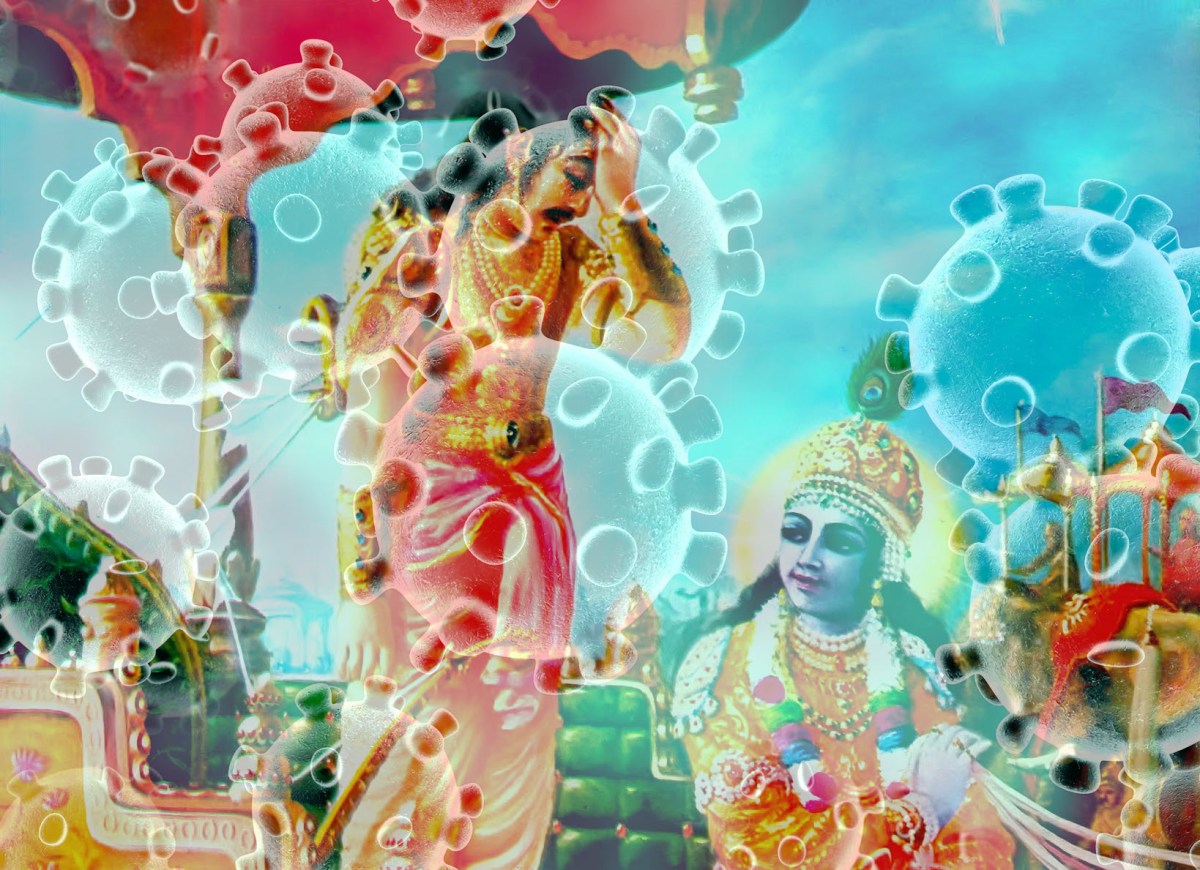
Arjuna – Krishna and the Corona Virus Crisis

Nobody expected that a small invisible virus would arrive one day and hold the whole world captive for months. Life is capricious. We can make hay till the sun shines. But then there is always a crisis lurking somehwere in the womb of time. We can either fear it or at best prepare for it. But it comes. Crisis is unpleasant but it also has a light, and an opening to a wisdom that is timeless. In this article I make an attempt to show how we can use this crisis to reflect and perhaps make a movement to acquire a wisdom that permanently takes us beyond all suffering: which no crisis can affect.

Categories
Advaitic Inquiries Pre-Witness Stage

Self inquiry and insight into one’s true nature/Self in Advaita

In this article, I have given an account of how one reaches the Advaitic insight of “I am Self/Witness”, following the traditional self-inquiry or Jnana Yoga of Advaita. This was an insight that gave me a kind of permanent home of peace that no outer crisis can touch. I wrote this to help others on the path of traditional Advaita.

Categories
Psycho-Philosophical Inquiries

The evolution of self : really evolution, or perpetual conflict?

Advancement of man is seen as evolution of self. In this article I show that since self is actually a fragment – a bundle of knowledge which is limited, no amount of evolution – of accumulation of knowledge – can make the limited go beyond limitations. And being limted and fragmentary, the self shall always divide man against man and man against nature.

Categories
Psycho-Philosophical Inquiries

What is psychological becoming and how it causes suffering?

Psychological becoming is an umbrella term for all our desires: material, emotional, intellectual and spiritual. In this article, I trace out the roots of this movement, which governs our personal and social lives powerfully and unconsciously. Thereafter I show how it constitutes suffering at all realms – material, emotional, intellectual and spiritual, even though our current society actively encourages and rewards it.

Categories
Psycho-Philosophical Inquiries

How to live a life free of effort?

Our society makes a virtue out of struggle and psychological effort. But is not psychological effort a result of conflict? Is it possible to live life without the conflict of psychological effort. In this response to a question I look at the root of psychological effort in our work life, and how one can do work without effort; when one does work for the sake of love.

Categories
Psycho-Philosophical Inquiries

Is psychological learning about correcting mistakes?

In society we are often chided for doing mistakes psychologically, by various forms of authority. These voices of authority go very very deep, forming and erecting codes of ethics within us. Do we ever question these voices of authority? Can we be free to learn about ourselves if we judge and label our thoughts and acts as mistakes in accordance with these voices? In a response to a question I look into the whole notion of what we call mistakes, and if psychological learning and freedom has anything to do with correcting mistakes.

Categories
Psycho-Philosophical Inquiries

Is there something called positive self image?

Ever since our childhood we are schooled by parents and society to create a positive self image. In an answer to a question, I look into whether there is anything called a positive self image, or whether all image construction is the root of human conflict and cause of global problems.

Categories
Psycho-Philosophical Inquiries

How to learn about oneself in the mirror of relationships?

We never, ever look into our relationships, which are based on creation of images, and is the root of all conflict in life. Our relationships are based on pleasure, security, attachment and approval. In this response to a question I look into how we can observe and learn about the whole process of construction of images in the mirror of relationships: if we wish to.

Categories
Psycho-Philosophical Inquiries

Is there discipline without control?

One is conditioned to think that discipline has to do with control. A system of ethics is erected by human thought to control behavior. But has ethics solved the problem of human conflict? In this response to a question I look if there is a discipline which is not about control.